
The Bottom Line: A marvelously unconventional crime thriller that is as cerebral as it is brutal.
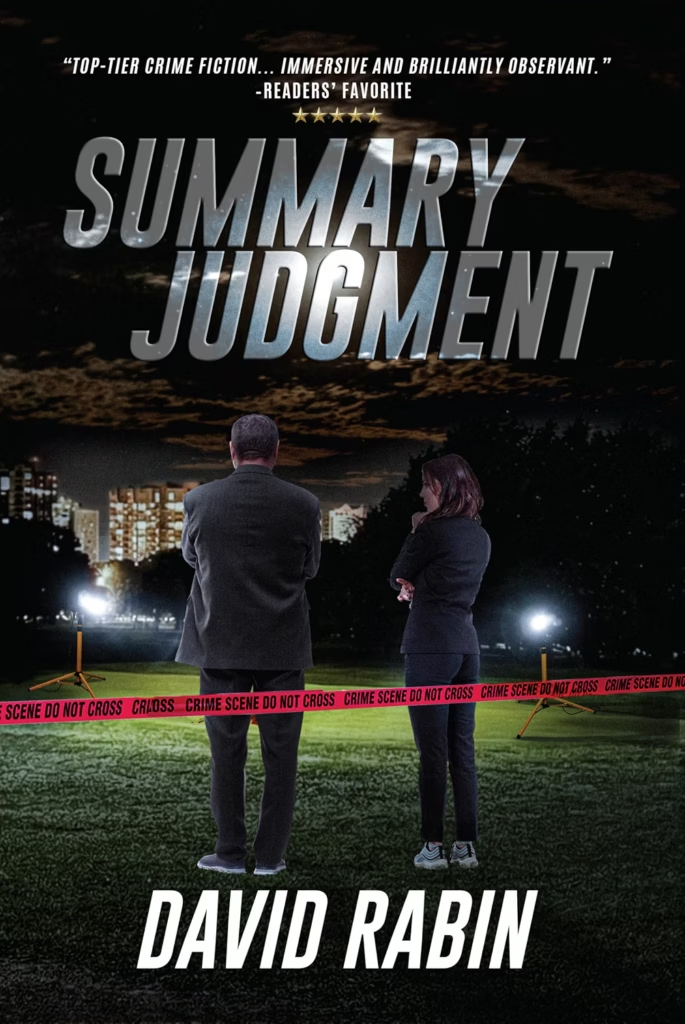
The second book in The Judgment Trilogy reunites Chicago detectives Marcelle DeSantis and William “Bernie” Bernardelli in a murder case that begins with a professional assassin luring publishing heir Ashley Bickerstaff to a deserted lakefront golf course. Instead of the promised sexual encounter, she plunges a knife into his abdomen and watches him bleed to death.
What should have been a clean assassination goes disastrously wrong when a teenage runaway witnesses the killing. Her decision to return to the crime scene and help the police demonstrates considerable courage, but she struggles to recall the killer’s face. And this is exactly where author David Rabin introduces the hook that makes the rest of the novel irresistible. With no conventional witness-protection arrangement available, Bernie proposes an extraordinary solution: placing her under the protection of Chicago’s powerful Torelli crime family.
Meanwhile, Rabin establishes further mayhem in an opening scene where the detectives’ formidable ally, John Shepard, penetrates an army general’s heavily fortified home to deliver a chilling warning.
Rather than manufacture easy breakthroughs, Rabin makes the resulting detective work unusually concrete. Suspecting that Ashley frequented bars in search of female companionship, Marcelle and Bernie interview escort-service operators, question bus drivers and search for evidence of his movements.
When these efforts produce little, Marcelle begins combing through mountains of handwritten taxi dispatch records. She discovers that Ashley repeatedly visited individual bars for several consecutive nights before moving on to another location. Yet his last documented taxi journey occurred more than two weeks before his murder. The discovery establishes a pattern without identifying where he spent his final evening, leaving the investigators with a formidable canvassing problem.
Fans of In Danger of Judgment, the trilogy’s first book, will recognize Rabin’s patient approach to connecting past and present, along with his fascination with clandestine operations, military tradecraft and the hidden connections between seemingly unrelated crimes. While the first installment explored international drug trafficking and its roots in the Vietnam War, Summary Judgment shifts the emphasis to corporate corruption and contract killing. The result is a more intricate police procedural, with financial forensics and painstaking detective work sharing the spotlight with the combat expertise that distinguished its predecessor. Here, Rabin allows readers inside the mind of the killer. Lana Garner is a calculating, sadistic professional whose pleasure in her work has created an unexpected vulnerability. She initially conceals the existence of the eyewitness from her superiors, knowing that admitting such a mistake could have serious consequences. Her determination to correct the error makes Miriam’s situation increasingly precarious.
The supporting cast brings warmth, humor and moral complexity to an otherwise brutal story. Bernie’s longstanding friendship with the Torellis blurs the boundary between policing and organized crime, while Miriam’s relationship with her imposing bodyguard, Anthony, provides an unexpectedly touching counterpoint. Throughout, Rabin explores loyalty, redemption and the uncomfortable possibility that doing what is right may sometimes mean operating outside the law.
As the investigation progresses, Summary Judgment expands from a seemingly isolated homicide into a dangerous confrontation involving financial deception, professional assassins and buried government secrets. Rabin reserves one of the book’s most intriguing revelations for its final pages, when a fresh interpretation of an earlier clue casts the assassins and their origins in an entirely new light. Highly recommended.