
The Bottom Line: A bold, high-voltage series debut where mind games meet mayhem. Dr. Cassidy Chord is a heroine built to headline a franchise.
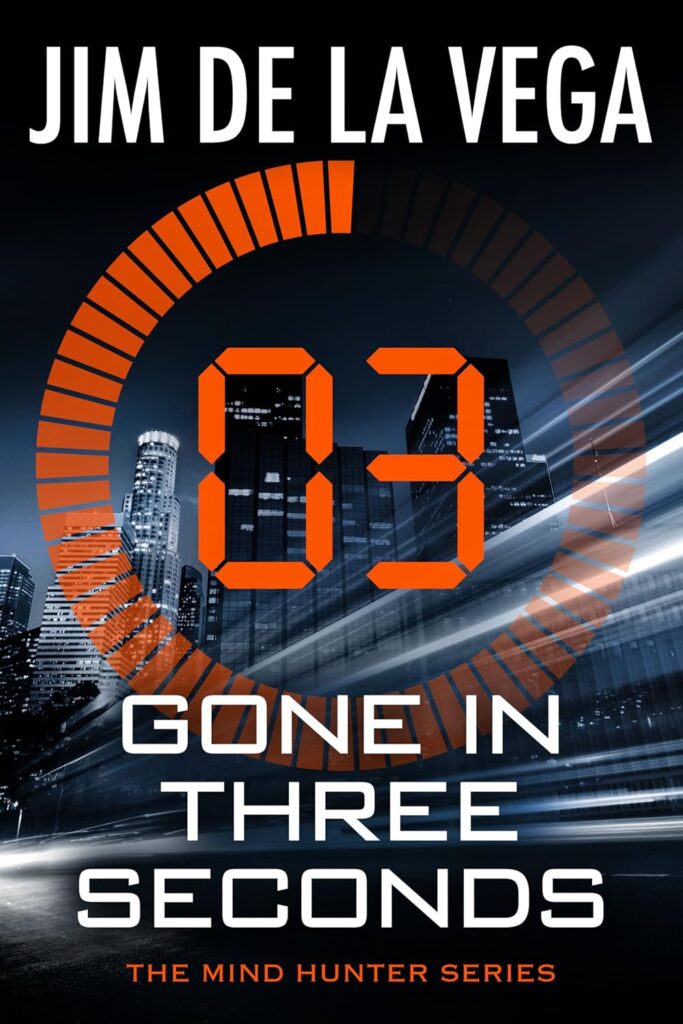
Gone in Three Seconds opens in the fluorescent chaos of a Los Angeles emergency room, where nurse Anne Thayer prays she won’t make a fatal mistake before her shift is over. The plea feels routine until a patient with a mysterious countdown tattoo explodes precisely on cue. In that instant, author Jim De La Vega establishes the central mystery, which is as hooky as they come.
Victims awaken with tattoos displaying a digital-style countdown ending in the word “BOOM.” When the clock hits zero, they detonate. No obvious trigger is detected. The working theory soon evolves toward the unthinkable: the tattoo itself may be the weapon.
The FBI forms a task force under Assistant Director Gregory Taft, a pragmatic, battle-worn leader already stretched thin by personal strain. Joining him is series-worthy heroine Dr. Cassidy Chord, a former combat helicopter pilot turned forensic psychologist. Cassidy lost her lower leg in an overseas explosion that also claimed her fiancé, and De La Vega uses her phantom limb pain not as decoration but as thematic glue.
From that moment forward, the investigation becomes a race not merely against a killer, but against physics, biology and the terrifying possibility that anyone in a crowd could already be a weapon.
De La Vega’s long career as a television news anchor and crime reporter quietly informs the novel’s realism. The mass-casualty sequences, especially a harrowing event at Dodger Stadium, capture not just physical destruction but the secondary wave of confusion, rumor and televised amplification that follows. Law enforcement briefings, bureaucratic tension and the scramble to control public narrative feel grounded in someone who understands how real crises unfold under cameras and breaking-news banners.
Yet the propulsion comes equally from the unseen architect behind the attacks. The attacks feel staged for maximum psychological impact, suggesting a perpetrator who relishes control and believes himself intellectually superior to those pursuing him. As the pattern intensifies, Cassidy, who is sharp, intuitive and emotionally volatile, isn’t merely part of the investigation. She may be part of the design. The bomber’s taunts and calculated gestures begin to narrow toward her, blurring the line between professional pursuit and personal fixation.While Cassidy anchors the narrative, Taft provides a steady institutional counterweight, embodying grit and duty as the bomber’s confidence grows.
Stylistically, De La Vega balances procedural detail with cinematic pacing. The science behind the “boom ink” remains just grounded enough to feel plausible, while the action sequences, especially those involving Cassidy piloting helicopters under extreme pressure, are rendered with tactile intensity. What makes Gone in Three Seconds compelling is not simply its ticking clocks, but its adversarial design. The visible countdown is only half the terror. The other half is knowing someone, somewhere, is watching to see who breaks first.