
The Bottom Line: A neo-Western thriller as rugged as its terrain and as haunted as the men who cross it. Highly recommended for fans of Craig Johnson and Cormac McCarthy.
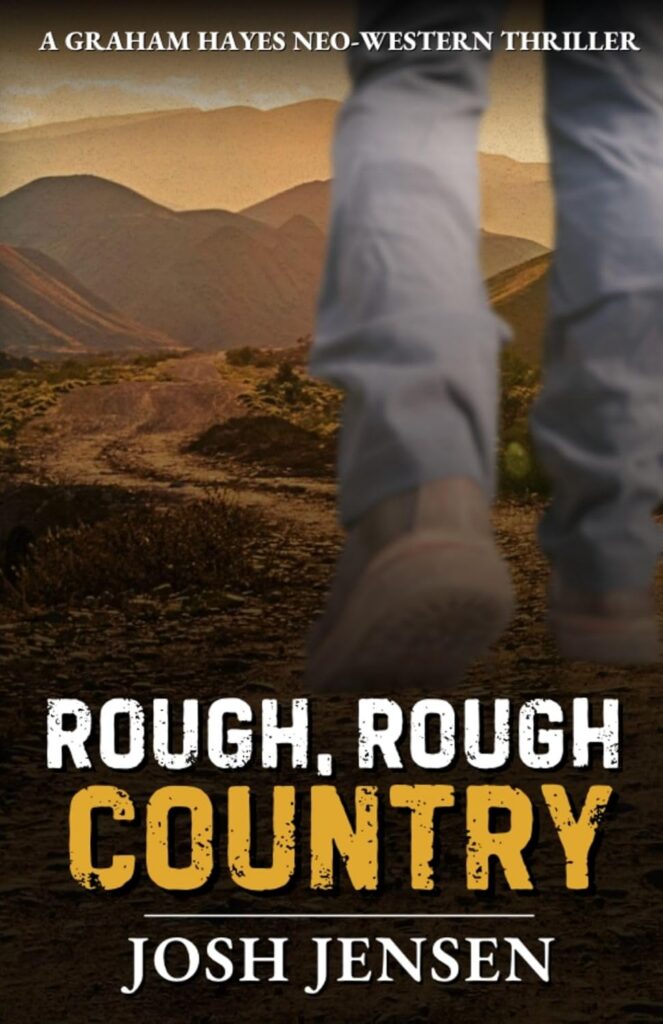
As Rough, Rough Country opens, a cartel-hired assassin known as The Texan is watching his mark in Las Vegas. The killing that follows is cold, controlled, and staged to mislead. Cut to Payson, Utah, where we meet 33-year-old former Army Ranger Graham Hayes. A former member of the Regimental Reconnaissance Company, Graham has property, a dog, his late father’s outfitter business to revive, and the habits of a former Army Ranger who has learned not to mistake quiet for safety.
Graham also carries an undeniable sense of dread. A cartel kingpin known as Montezuma has reason to want Graham dead after a local run-in that turned violent. Graham understands that any retribution could endanger the people closest to him. His mother, his brother Colt, his young niece Lily, and the fragile revival of Rough Country Outfitters all sit inside the blast radius of whatever is coming.
Author Josh Jensen builds the early suspense through chapters told from The Texan’s point of view. The assassin arrives in Utah under cover, rents a house, watches Graham’s office and harvests local gossip, weaponizing Payson’s small town community into actionable information.
If the book’s title sounds like it could be a lost Cormac McCarthy novel, the artistic similarities, fortunately, don’t stop there. While Jensen is far more adept at creating emotionally available characters, he does share McCarthy’s gift for using the landscape to help define Graham’s psychological state. Here, canyon country is simultaneously cinematic, exposed, familiar and dangerous. Graham knows the area’s roads, ridgelines, weather and properties intimately enough to seek refuge in them, but they also become lethal tactical spaces once The Texan and other threats arrive. The landscapes are remarkably well-drawn without slowing down the pacing, making Rough, Rough Country is a book that feels sharply visceral.
When Graham calls in Luis Romero, a fellow former Ranger and one of the few men he trusts, the book finds its central dynamic. Their relationship is built on shared history, dry humor, and the kind of confidence that comes from having survived danger together. After a gunfight in the mountains makes clear that the threat cannot be waited out, the story pivots from defensive vigilance to a more dangerous question: what Graham and Luis are willing to do before Montezuma reaches the people they love.
One of the novel’s strengths is the way it sets violence against domestic responsibility. A particularly telling early scene has Rebecca bring him the old Rough Country Outfitters sign, its weathered image of mountains and a bull elk carrying more emotional weight than the business itself. The sign is a reminder of his father’s dream, but also of Graham’s uncertainty about whether he can build anything permanent without dragging war behind him. From there, the novel widens into a harsher journey, one that tests Graham and Luis physically, tactically, and spiritually. As the book progresses toward its climax, Jensen is less interested in puzzle-box twists than in hard reversals. Ambushes that change the direction of the story, alliances that prove unstable, and sudden eruptions of violence force Graham and Luis into increasingly desperate choices.
The result is a neo-Western thriller that asks the uneasy question of whether violence can ever truly settle violence. While Rough, Rough Country is the second book in Jensen’s High Country Frontier series, the book can easily be read as an entry point to the series.