
The Bottom Line: One of the year’s best supernatural thrillers. Written with clinical authenticity and paranormal suspense, Do Not Resuscitate finds terror in the thin line between resuscitation and resurrection.
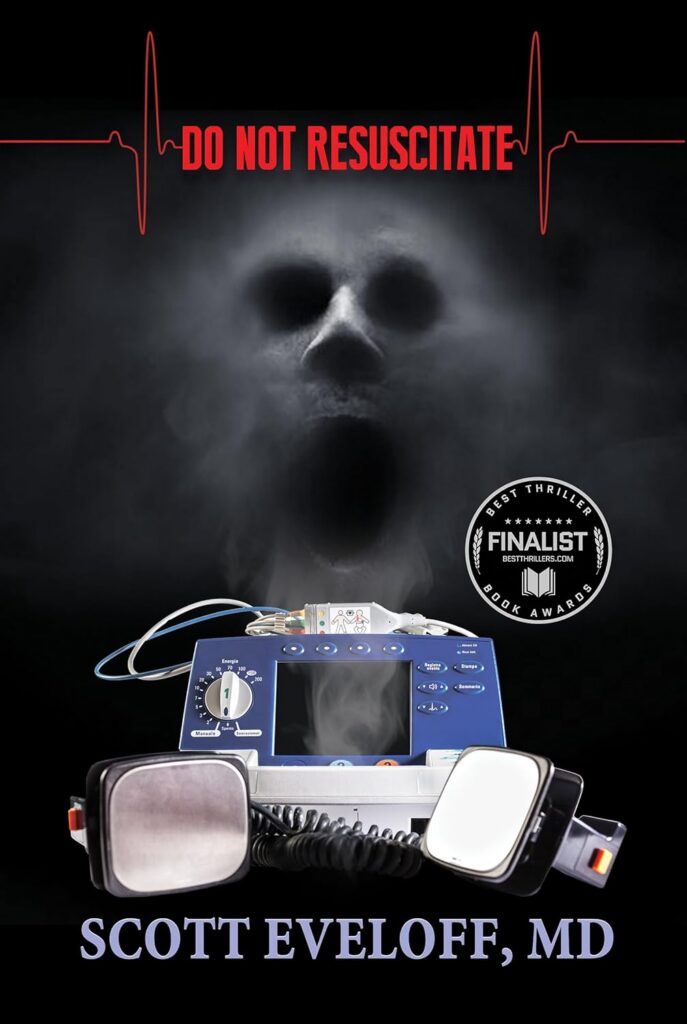
Twenty-six-year-old medical intern Harry Lindmark is working the Intensive Care Unit at a hospital in Providence, Rhode Island, when a patient grabs his arm and demands that his chart be marked, “Do Not Resuscitate.” But Leland Travis is far from an ordinary patient. The seemingly delusional former hospital physician insists something in the hospital is killing patients, and that he may eventually be among its targets.
Author Scott Eveloff, MD, a pulmonary physician who has appeared on The Dr. Oz Show, ABC’s 20/20, and Inside Edition, tells the story in Harry’s voice, which effectively heightens the tension in every scene. Through Harry’s perceptions, we experience the intern dealing with the stern authority of a senior resident as well as the emotional risk of reassuring a family whose son may or may not survive the night. Harry is also new enough to know how much he still needs to learn.
Eveloff raises the stakes when a young, badly injured but potentially recoverable trauma patient suddenly dies after a mysterious insulin drip appears. Who ordered the drip? The terrifying possibility comes via the official order trail: the insulin appears in the hospital system under the name of Leland Travis, the ICU patient who warned Harry about killers within the hospital.
What begins as a mystery of potential medical sabotage pays off with a supernatural reveal, answering the question of exactly why Travis was so desperate not to be resuscitated.
Much of the book’s early suspense comes from watching Harry try to separate ordinary medical crises from deliberate harm. His supervising resident, Martin Bethany, is abrasive, brilliant and suspiciously present when emergencies erupt. The hospital’s older spaces add another pressure: underground tunnels, dim corridors and institutional memory sit uneasily beside modern computerized care. Eveloff is especially effective at portraying how the machinery of healing can be turned into machinery of death.
Elsewhere, Harry’s private life gives the book its emotional undertow. He and his wife, Connie, are grieving the death of their infant son, and his punishing hours at the hospital have left her largely alone with that loss. The domestic scenes help to explain why every parent at a bedside matters to Harry. A small birthday celebration for Audrey, the sharp, disabled daughter of Connie’s new friend Denise, is especially telling. The party is tender, awkward and quietly painful, and it broadens the novel’s concern with how fragile lives are valued.The surrounding cast keeps the story from narrowing into one doctor’s breakdown. Sylvester Morrow is the former physician whose shadow reaches across the hospital’s past and present. Charlie Washington, an elderly orderly who knows the hospital’s hidden history, becomes a wary guide through its darker possibilities. Even Martin Bethany, with his temper and clinical command, gives the book a useful uncertainty, as he may be bully, savior, suspect or some combination of all three.
Do Not Resuscitate works because its paranormal horror remains tied to procedure, grief and responsibility. Its supernatural threat is frightening precisely because it moves through the ordinary systems doctors trust to save lives.