
The Bottom Line: Timely and irresistible. Bultema’s authoritative command of military hardware, tactics and high-stakes geopolitics makes tomorrow’s war feel dangerously near.
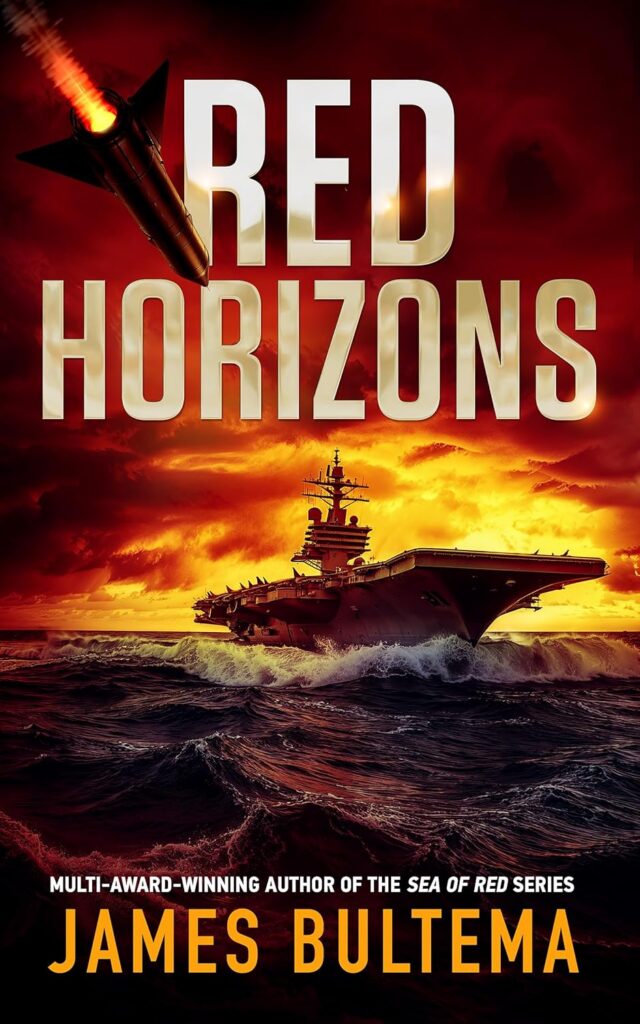
Red Horizons, the latest book in James Bultema’s Sea of Red series, begins as North Korean Captain Kim Min-jun runs for the South Korean border with a USB drive sewn into his uniform. He carries evidence of the Silent Tide Initiative, a plan for a nuclear first strike against the United States designed to confuse its enemies about the attack’s origin and motive. If caught, Kim will be executed as a traitor. If he succeeds, the evidence he carries may be the only chance to stop a war before it begins.
The plot widens quickly from the DMZ to Pyongyang, Washington, Hawaii, Japan, the Sea of Japan, and the covert routes into North Korea’s borderlands. In Pyongyang, Choe Jin-su maneuvers through the aftermath of Kim Jong-un’s death, consolidating power and promoting a doctrine based on fear and strategic ambiguity. In Washington, newly elected President Samuel Preston must decide how much to trust incomplete intelligence. In the Pacific, U.S. and allied commanders begin piecing together missile tracks, surveillance gaps and hidden facilities.
Series fans will rejoice at the return of Navy F-35 pilot Jessie “Swagger” Hampton, the book’s most accessible emotional anchor. Through a touching scene in which Jessie coaches a children’s softball league, Bultema demonstrates what a natural family man he could be. The subject is an intriguing source of tension with his wife, Sarah “Danger” Freeman. An E-2 Hawkeye pilot and electromagnetic warfare officer, Sarah isn’t sure she wants a child, fearing that parenthood would force one of them to give up the cockpit.
Around them, Bultema assembles a large but purposeful supporting cast: CIA paramilitary officer Dallas Steele, Iranian defector Ali Karimi, submarine commander David Harrington, President Preston and his advisers, and a number of pilots, commanders, analysts and sailors who each see only part of the crisis. As in Red Lines and Arctic Red, the hardware matters, but it matters most because people must interpret it under pressure. Bultema’s cast also demonstrates that uncertainty can be nearly as frightening as war. On the North Korean side, Choe Jin-su emerges as the principal antagonist, a calculating new leader who sees ambiguity, fear, and nuclear risk as tools of statecraft. While fictional, the book arrives at a moment when North Korean troops have been fighting alongside Russia in Europe, lending the story a sense of immediacy and believability that goes beyond ordinary speculation.
The result is a military thriller that moves on several levels at once. Bultema proves again that there are few novelists better at moving from a covert crossing to a White House meeting, from a submarine mission to a carrier deck, from a marriage argument to a missile launch, without losing the thread. While readers familiar with the series will be engrossed in Jessie and Sarah’s evolving arcs, newcomers can easily enjoy Red Horizons as a standalone novel.