
The Bottom Line: A fiercely entertaining serial-killer thriller that weaponizes doubt and never lets justice off the hook.
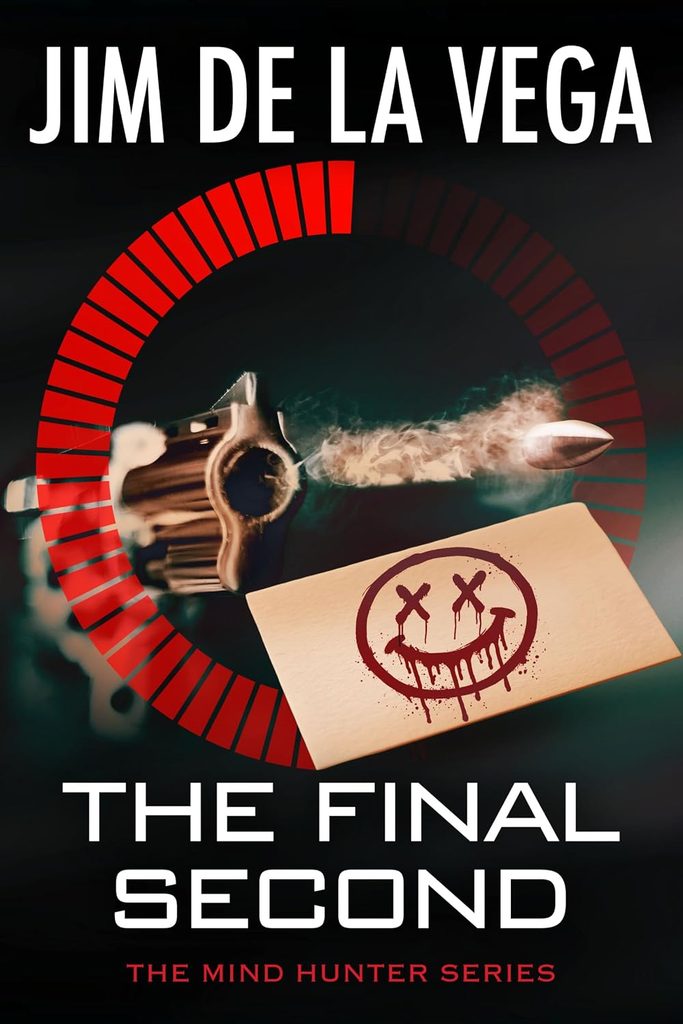
The Final Second opens where most serial-killer thrillers would end: in a Georgia execution chamber. Eddie Ray Calhoone, convicted of seven murders attributed to the notorious Blood Smile Killer, is put to death as Sheriff Parker Chord watches. The victims were shot through the heart, each left with a grotesque smile drawn in blood around the lips. But moments after the execution, Chord receives a package containing a preserved human eye taken from the killer’s final victim, along with a chilling message signed with the killer’s taunting alias.
That same night, the wife of the judge who presided over Calhoone’s trial is murdered in the same distinctive fashion. In that instant, De La Vega establishes the novel’s central mystery, which is as unsettling as it is compelling: What if the justice system executed an innocent man while the real serial killer remained free?
The second novel in Jim De La Vega’s Mind Hunter series marks the return of Dr. Cassidy Chord, a forensic psychologist and helicopter pilot with a military background. Cassidy remains sharp, intuitive, fiercely independent and occasionally reckless. Having lost her right leg in an explosion, she has learned to navigate physical challenges without surrendering her appetite for danger.
But this case carries a different emotional burden. Her older brother helped send Calhoone to his death, and now he must confront the possibility that the justice system executed an innocent man, forcing him to reckon with the consequences of his own certainty.
De La Vega carries forward the series’ fascination with killers who turn murder into an exercise in timing, manipulation and psychological domination. In Gone in Three Seconds, victims bore explosive tattoos that ticked down toward detonation. Here, the ticking clock is less literal but no less menacing, measured in cryptic deadlines and threats against those closest to the investigators. An early appearance by FBI Assistant Director in Charge Gregory Taft provides another connection to the first novel, while Cassidy’s aviation knowledge and instinct for confronting danger remain familiar strengths. Yet the shift from the Los Angeles bombings to rural Georgia and the possibility of a wrongful execution gives The Final Second a more intimate, morally unsettling dimension. The danger is no longer simply that innocent people may die, but that the institutions entrusted with protecting them may have helped the killer succeed.
The murderer known as Grin orchestrates elaborate psychological spectacles, planting grotesque clues, manipulating evidence and exploiting the investigators’ assumptions. Preserved eyes, human teeth, cryptic messages and carefully timed threats turn the investigation into a macabre contest in which the hunters repeatedly find themselves becoming the prey. The killer’s apparent familiarity with law enforcement makes every lead suspect and every trusted relationship potentially dangerous. De La Vega balances procedural detail with cinematic pacing, shifting between law enforcement briefings, investigative discoveries and scenes of escalating personal danger. At times, the elaborate criminal schemes and exuberant descriptive flourishes strain plausibility, but the narrative’s momentum rarely falters.
De La Vega broadens the tension through Jessica Diaz, an ambitious Atlanta television reporter whose father, a former sheriff debilitated by a stroke, was among the few investigators who doubted Calhoone’s guilt. Jessica’s pursuit of the story places her in Grin’s sights, while rivalry within the newsroom underscores how easily a public tragedy can become a competition for exclusive stories and airtime. The media coverage doesn’t merely document the unfolding terror. It becomes another stage on which the killer can perform.
Yet the novel’s propulsion comes equally from Cassidy’s evolving understanding of the mind behind the murders. She begins to recognize that the killer’s elaborate staging is more than sadistic exhibitionism. Each crime, each souvenir and each taunt reveals something about a personality obsessed with control, recognition and intellectual superiority. The clues are not simply evidence to be collected. They are expressions of a psychological design, suggesting that catching Grin will require not merely following the evidence, but understanding the mind that arranged it.