
The Bottom Line: A seductive, timely and captivating psychological thriller for anyone wondering how much autonomy we will trade for comfort.
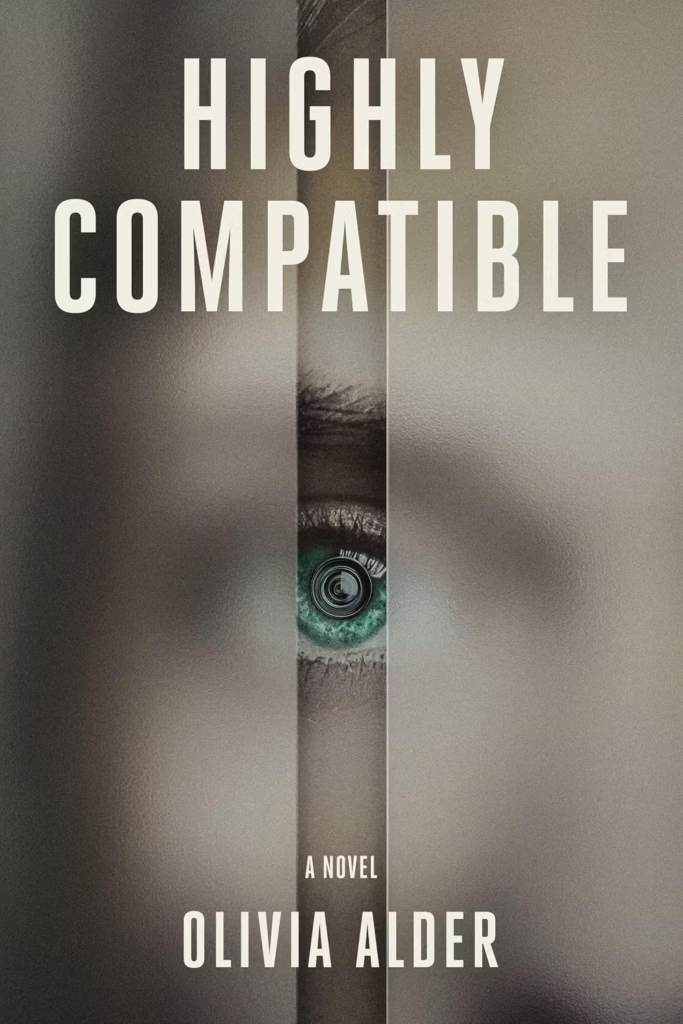
In Highly Compatible, thirty-year-old Nina Jacobs is already living inside the future she helps sell. She works in Product Marketing at Panopteia, a powerful Silicon Valley AI company whose systems can anticipate a coffee order, monitor wildfire conditions affecting her family’s county, and turn vast quantities of personal data into something that feels less like surveillance than highly personalized care.
Nina’s particular talent is making unsettling technology sound trustworthy, and she is exceptionally good at it. Then she meets Vincent Stone, a brilliant engineering fellow whose quiet attentiveness makes the same promise on a more intimate scale. Vincent anticipates Nina’s needs with unnerving precision. The romance has real heat, including deliciously explicit scenes, and Alder makes Nina’s attraction to Vincent feel intensely physical.
It would be natural to assume that Vincent is a humanoid robot (ala Ava in Alex Garland’s Ex Machina), but author Olivia Alder has something far more original in mind. Vincent is fully human, but his unnerving attentiveness mirrors the technology he helped build. Both promise Nina the comfort of being understood before asking her what it may cost her.
Structurally, Alder’s debut novel defies the conventional psychological thriller journey in which a protagonist is called toward danger and initially tries to escape it. Instead, Nina’s call to adventure offers exactly what she has spent her life pursuing. Professional recognition, proximity to power, and the intoxicating feeling of having her needs met are nearly impossible to resist. Alder gives Nina’s psychological arc a clear destination, but the suspense lies in wondering whether increasing her awareness will lead her toward rebellion or conscious complicity.
In an immersive world that builds impressively with each chapter, Alder is careful to surround Nina with drama. Her friend Evan, an engineer increasingly disturbed by what the company is building, worries about the consequences of treating prediction as evidence. His warnings become harder to dismiss when Nina discovers how much Panopteia can infer from a supposedly private conversation between them, including their movements, device activity and vocal stress. For a moment, the company’s promise of frictionless care looks much more like surveillance. Throughout, Vincent remains the novel’s most complicated figure. He is neither an obvious villain nor simply a romantic ideal, and that ambiguity gives the story heft.
The novel’s ending will undoubtedly make for spectacular book club fodder, as it is sure to divide readers. For those drawn to morally gray characters, seductive technology and psychological suspense, Highly Compatible will, yes, feel like getting exactly what you wanted all along.
As a bonus, head over to Panopteia.com. The terrifying truth is that the company does not look out of place among numerous AI-native startups, and that makes the story all the more captivating.