
The Bottom Line: A muscular, mind-bending and profound thriller where hidden power bends the rules and unlikely heroes must decide how hard to push back. Five stars.
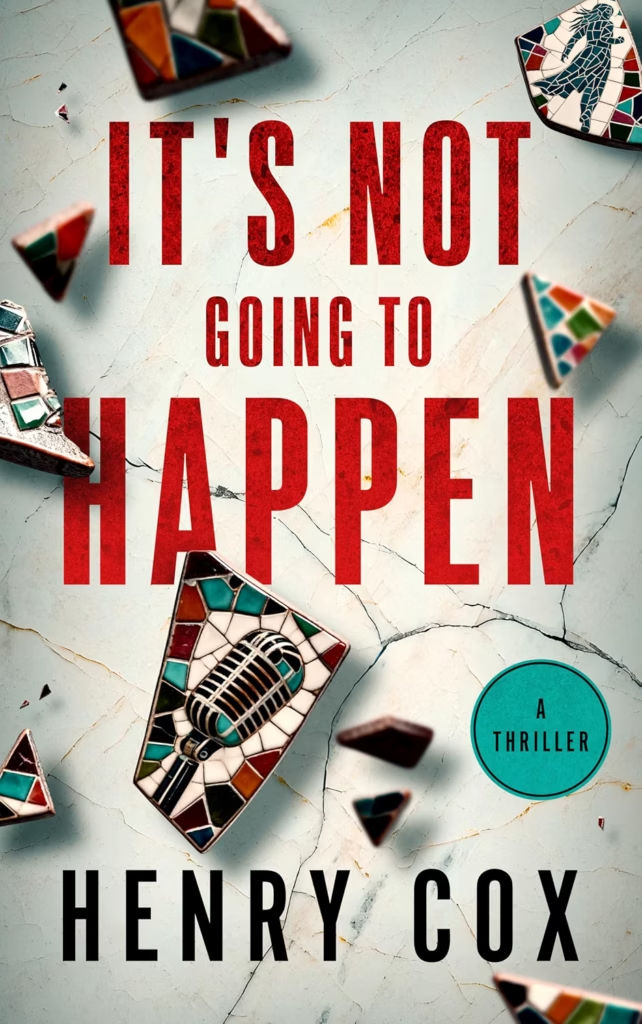
How much agency do ordinary people really have when powerful people shape not only the choices before them, but the consequences that follow?
It’s Not Going to Happen reads as both defiance and warning. It is what characters tell themselves when they believe training, willpower or moral certainty can hold the line. But author Henry Cox keeps pushing them into volatile situations where unseen forces have already changed the terms.
The novel initially reads like three high-stakes stories running in parallel, but Cox gradually braids them into a single international thriller about talent, coercion and consequence. The book opens in San Francisco, where fifteen-year-old Kansas ranch girl Julieta Winfield is reluctantly tagging along with her older cousin Raquel at a modeling-agency appointment. The visit should be a small family obligation, but it detonates into something far stranger when a distraught model stumbles into the lobby with a revolver. As adults freeze, Julieta moves with startling clarity, kicking the gun away, ordering help, and revealing the kind of calm that cannot be faked.
In Spain, young scientist Santino Castillo is working on biologic nano-technology that could transform healthcare by attacking disease at its source, but the promise of healing draws the attention of people more interested in leverage than medicine. In Missouri, Otto “Otter” Perdue, a foster kid with long odds and a hard-earned sense of discipline, is trying to turn football, school and work into a future before violence rips open his life.
The entertainment industry, covert intelligence work and medical science appear to orbit separate worlds until Cox begins revealing the hidden machinery connecting them. What begins as a country cousin’s awkward trip to the city becomes the first collision point in a sprawling thriller about celebrity, clandestine power, biologic nano-technology and the consequences of being unusually prepared.
The book’s governing idea is that life is shaped by patterns of choice, including choices people never knew they were making. Cox plants this in the prologue, and then spends the novel testing it under pressure. Thankfully, the thesis holds up. Cox is interested not just in whether people can survive a crisis, but whether survival leaves them free.
Cox’s villains are not all members of one cabal. Some are predators acting alone, while others belong to coordinated networks that can bend intelligence, public narrative, finance, law and science until coercion looks like reality.
Readers of Cox’s earlier Deceit novels will recognize the author’s taste for big structures, technical ideas and hidden chains of command. As in Deceit of the Mind, theory is not window dressing. It actively changes what the characters fear, value and risk. As in Deceit of the Manna, science with humanitarian promise can become a geopolitical threat when secrecy and ambition take control. It’s Not Going to Happen has connective tissue to those books in structure and temperament: wide ensemble, escalating stakes and a willingness to let technical ideas share the stage with grief, violence and personal reinvention.
As in Cox’s other large-scale thrillers, the pleasure here is partly in watching the scope widen. Film sets, hospitals, ranches, research laboratories, military-adjacent technology and European back rooms begin to form a single field of consequence. That density may be a lot for readers who prefer a narrow chase plot, but those who enjoy interlocking storylines will find plenty to track. There are shocking reveals and sharp turns ahead, and Cox is careful to make many of them grow out of character rather than simple authorial ambush.
Cox has delivered an expansive, richly layered thriller about how the seemingly impossible manages to arrive over and over again, and the few people prepared enough to meet it.