
The Bottom Line: A must-read blend of horror, crime and comedy that reinvents the predator-versus-predator thriller.
Warning: this review may contain spoilers!
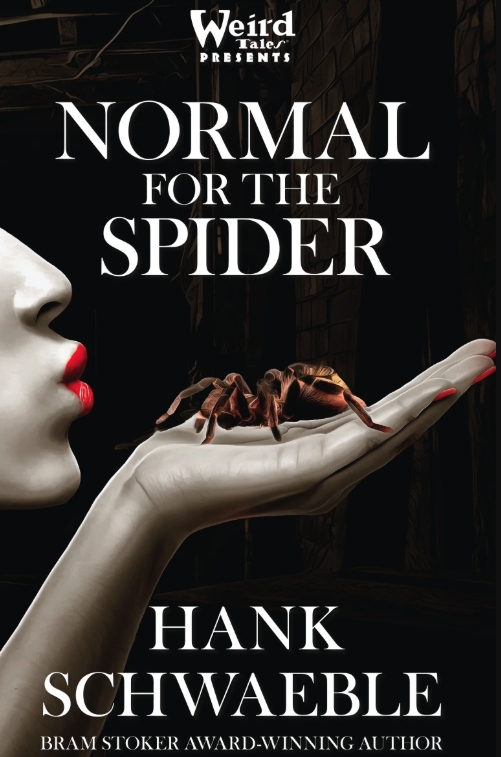
Normal for the Spider opens in an unnamed American city as Sienna Shaw, a practiced thief and experienced killer who committed her first murder shortly after turning fourteen, realizes she is being followed. Seeking to lose her pursuers, Sienna slips into a bookstore and follows the proprietor, Bob, to what he presents as a safer hiding place. Little does she know that the innocuous storefront conceals the secret meeting place of the Book Club, an organization of highly capable criminals who want to frighten powerful executives, political figures and other self-appointed masters of society by showing them how vulnerable they really are.
It seems that Sienna has already crossed the Club without knowing it. She unknowingly killed one of its members, stole more than $25,000 belonging to the organization and disposed of his body so effectively that the Club had difficulty finding it. That doesn’t mean she’s safe. Schwaeble’s first strong choice is to put Sienna in the unfamiliar position of being prey. She finds herself locked underground and forced through a lethal gauntlet involving a rabid woman, a corpse and a deeply disturbed man who believes himself to be a vampire and has spent thousands transforming himself to look the part.
Survival earns her an invitation to join the club, which she accepts. Soon she is participating in elaborate criminal operations, even as the Club’s grand plans for terror are destabilized by the poisoning of one of its own.
Schwaeble gives the novel a strong vein of black humor, much of it arising from the contrast between the Book Club’s horrific activities and the almost cheerful professionalism with which its members discuss them. Readers may grow to love Bob, the organization’s wealthy and exuberant founder, who approaches elaborate acts of terror with the genial enthusiasm of someone planning an unusually ambitious social event. Elsewhere, the club’s members are hilariously competitive. After one killing, Sienna gets dressed down by a rival for stealing his thunder: “Such a lack of decorum. A sign of poor breeding.” She retorts by accusing him of slaughtering his colleagues “in a manner straight out of Emily Post.”
In Sienna, Schwaeble has created an antihero the reader is invited to understand rather than excuse. Much like Jeff Lindsay’s iconic title character in Dexter, Sienna doesn’t see herself as a serial killer, and lives by her own moral code. While she’s never exactly sympathetic, her personal standards are what make her compelling.
At its core, this is a story about people convinced they understand the food chain, until something starts hunting them. As the story widens from urban crime and surveillance toward isolated, horror-inflected suspense, Schwaeble delivers a string of satisfying reversals. The book’s violence is explicit and its fascination with technical detail can occasionally interrupt the momentum, but Sienna’s calculating presence and the novel’s predator-versus-predator design give it a distinctive pull.