
The Bottom Line: Wickedly funny and emotionally raw, The Dark Lottery is a murder mystery with a hero you’ll be quoting long after the last page.
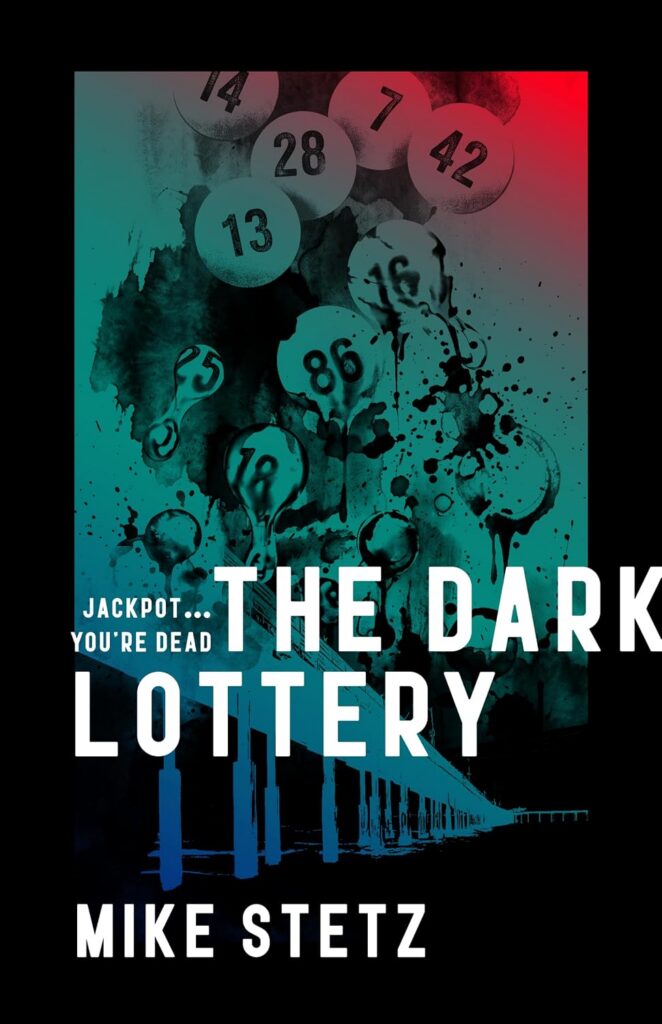
As The Dark Lottery opens, twentysomething San Diego house painter Connie Keen is staring at the ruined Ocean Beach pier. Twenty years earlier, his much older brother Kenny went over the railing after sneaking onto the closed pier to party with friends. Drugs and alcohol were found in Kenny’s system, and police quickly ruled his death an accident.
These days, Connie is an anxious binge drinker who lives in a converted garage behind his mother’s house. But everything changes when Lucy Dove, a stranger on a mission to make “karmic amends,” finds Connie in a bar with new information about Kenny’s death. It seems that Lucy’s deceased sister Holly left her with a deathbed revelation to pass along to Kenny’s family. He did not fall from the pier. He was pushed.
Author Mike Stetz tells the story from Connie’s point of view, which is strikingly sarcastic, defeatist and hilarious (“I’ve never read the Bible, but it sounded like a Bible thing”). It’s easy to imagine the opening credits to the screen adaptation rolling to Beck’s Loser. And yet Connie is also philosophical, hence the concept of “the dark lottery,” which describes the cruel randomness of life that can kill anyone, anywhere, without warning. Connie’s fierce attachment to the brother he barely had time to know makes his investigation fascinating and emotionally credible.
Connie digs through Kenny’s belongings and obtains the original police report while tracking down people who were on the pier. Stetz delivers a key turning point when Connie turns to Stan Mackey, the retired San Diego detective who investigated Kenny’s death (Connie invites Mackey to breakfast because “Cops like diners, at least according to movies”). Mackey reveals that aspects of the case troubled him. The witnesses’ stories were unusually consistent, and some people on the pier were never identified. One of the strongest early sequences sends Connie onto the Ocean Beach pier with Mackey. Connie can surf beside the structure, yet can barely bring himself to walk across it. Retracing his brother’s final night becomes both an investigative exercise and a confrontation with the trauma Connie has spent two decades drinking around.
Connie pushes on. He is persistent and perceptive but also frequently drunk and capable of startling violence. His general demeanor makes his amateur investigation dangerous even before he begins reaching people who may have reasons to keep the past buried.
Stetz’s depiction of San Diego surf culture and dive bars gives the story a distinctive sense of place, while Connie may be one of the most memorable protagonists we’ve read all year. Connie’s search ultimately poses two compelling mysteries at once: what really happened to Kenny, and whether a man who has spent twenty years expecting catastrophe can learn to participate in life again.