
The Bottom Line: This Victorian murder mystery has all the ingredients for a blockbuster: a sealed room, an unsolved murder and revelations that make you question everything you think you know.
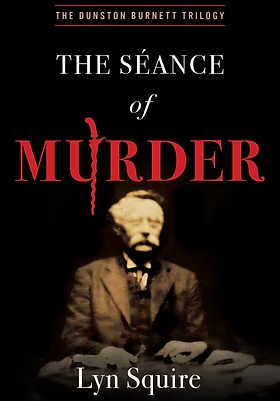
Set in Victorian England, opens with the arrival of retired bookkeeper Dunston Burnett at Crenshaw Hall, a dark, fortress-like estate outside Cambridge. Dunston has been summoned by the dying Sir Hugo Crenshaw, an elderly relative he scarcely knew he had. He finds the family preparing for a séance on the fiftieth anniversary of a notorious unsolved crime – the stabbing of Randolph Crenshaw, then heir to the baronetcy.
It seems that the murder took place in the estate’s reading room half a century earlier. Sir Hugo’s grandson Luke hopes that reopening the room, sealed for decades, may bring some kind of forgiveness or release. Dunston soon learns that Luke is keen to include him in the gathering because eight is considered the most auspicious number of attendees for the séance.
The morning after the séance brings the discovery of a new murder victim. From here, Lyn Squire gradually transforms Dunston from an awkward bystander into an amateur sleuth. Dunston is shy, self-conscious, physically unheroic and acutely aware of his own awkwardness. Yet those qualities make him an excellent observer. He notices people from the edges of rooms, listens carefully, and feels the social pressure points in a household divided by resentment, inheritance and secrets.
In that sense, Squire’s method is closer to the great tradition of British crime fiction built on enclosed worlds and concealed motives than to the high-velocity mechanics of a contemporary thriller. He is especially good at depicting misdirection, social tension and the uneasy overlap between superstition and calculation.
What gives The Séance of Murder its power is that the early gothic setup does not remain merely atmospheric. It pays off in a chain of revelations that steadily reframe what the reader thinks the story is about. The book then widens from a séance mystery into something more layered and urgent, drawing together family history, hidden motives, social entanglements and the dangerous consequences of misreading both people and events.