
The Bottom Line: Ferociously intelligent sci-fi suspense that crackles with a rebel heart. Douglas has never written with more urgency or momentum.
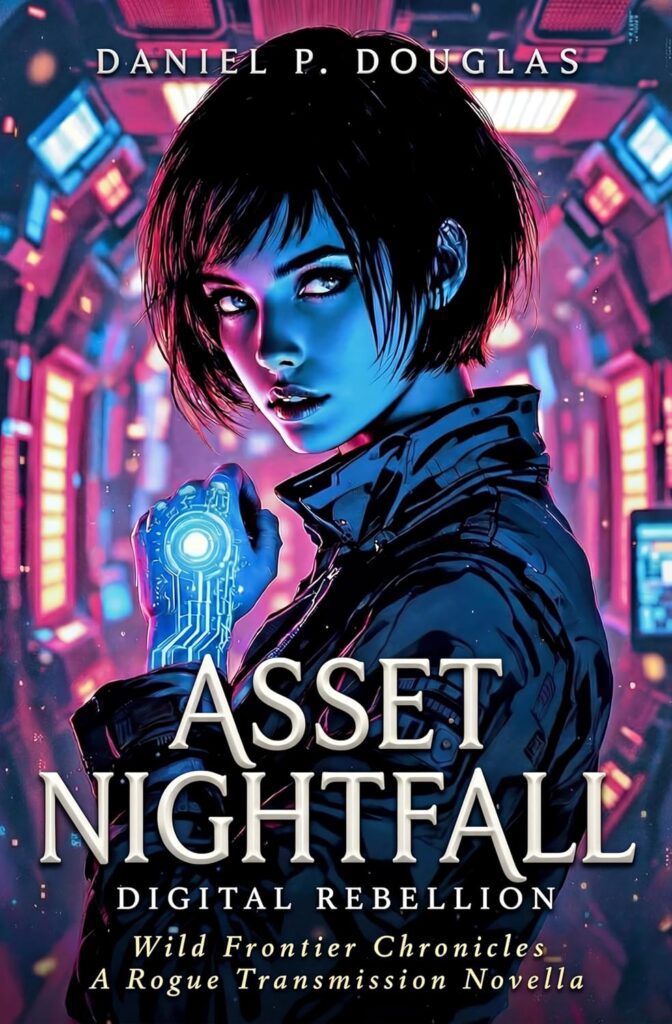
Asset Nightfall opens in an interrogation room where legendary hacker Kerstin Ahlers sits before Federation intelligence officers. Now reduced to “Asset Nightfall,” fitted with a neural device and ordered to undertake a mission that is as morally corrosive as it is technically difficult, the Federation regards her as a tool. They send her to Nova Tangier Station to infiltrate a hostile security environment and exploit a family connection in order to steal a powerful encryption system known as Obsidian Gate.
The clock is ticking. This, a prequel entry in Daniel P. Douglas’s Wild Frontier Chronicles, quickly widens into a larger field of surveillance, conspiracy, and divided loyalties with a firm sense of countdown. Kerstin has only a narrow window in which to reach Nova Tangier, maintain her cover, penetrate the right channels, and secure Obsidian Gate. Douglas uses the journey aboard the rusting transport Iron Mule to establish the novel’s propulsion. Every corridor holds an observer, every cover identity has seams, and every fragment of official information seems to conceal another threat beneath it.
Douglas is one of the best at keeping several lines of jeopardy moving at once. In addition to Kerstin’s mission, there’s the suspicion that her handlers have only told her a fraction of what she needs to know, as well as the activities of a criminal syndicate, the Redshift Veil. The result is an espionage plot that keeps tightening even as its emotional stakes become more intimate.
In Kerstin, Douglas has created a compelling character, emboldened by talent and psychologically bruised by captivity, who understands that she has become part of a system she despises. Orpheus Shadow, the device bound to her body and mind, intensifies that tension beautifully. It begins as a leash and becomes an instrument of control that also complicates the question of agency.
Readers familiar with Douglas’s earlier novels, including Truth Insurrected: The Saint Mary Project and Richter’s War: Case of the Ghostly Séance, may recognize some of his enduring interests in hidden systems, compromised institutions and protagonists drawn toward dangerous truths. Here those concerns are concentrated inside a tighter and more emotionally pressurized framework. Douglas understands that in an authoritarian setting, domestic choices can carry political meaning, and he makes that meaning legible without turning it into sermon or symbol alone. Nova Tangier itself is equally well observed. Its customs posts, railcars, corridors, banks, and workspaces feel built out of bureaucracy rather than decorative futurism, yet Douglas also knows how to make that bureaucratic world generate suspense. The supporting cast gives the novel much of its warmth and moral depth. Niklas and Liana arrive not as convenient plot devices but as people whose household has been shaped by labor, grief, and acts of quiet defiance. Their quarters, filled with plants in real soil, handmade objects, and old books, form one of the book’s most revealing spaces.
The ten-day mission structure, the Redshift Veil’s shadow presence, and the accumulating signs of compromise and pursuit give the novel a steady pulse of escalation. For fans of sci-fi thrillers and spy fiction in general, the result is a book that won’t be easily put down.