
The Bottom Line: A fast, intelligent and emotionally sophisticated spy thriller debut. Fans of Saul Herzog and Mark Greaney will devour The Woulfe Intrusion and hope for an entire series.
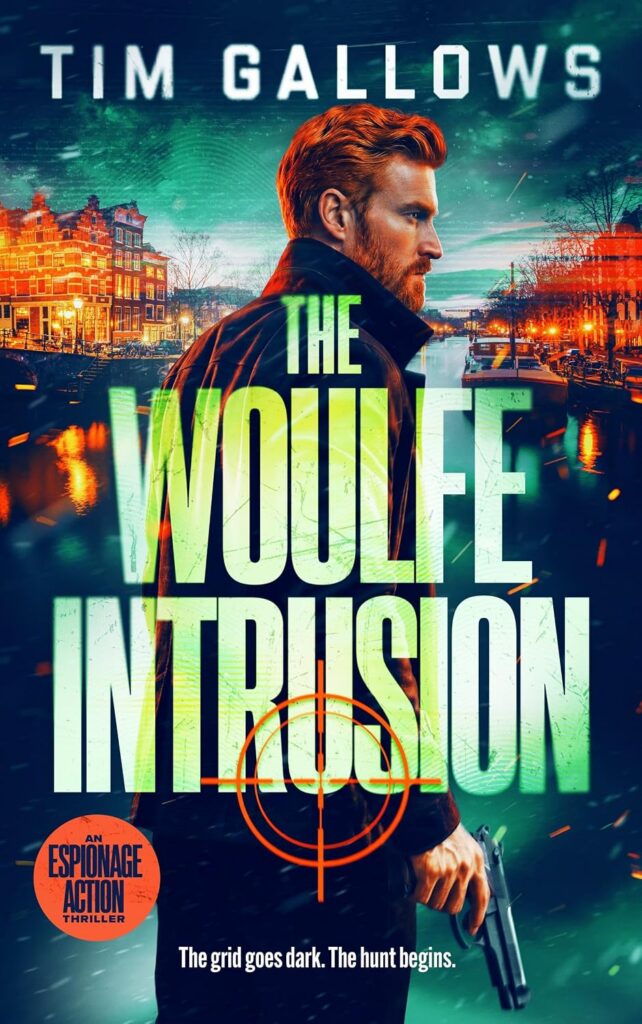
The Woulfe Intrusion opens in Lucerne, where Noah Turner, a young American cybersecurity engineer and penetration tester, races through the snow to the railway station, disables its cameras, makes a coded farewell call to his father and abandons his phone on a Venice-bound train to misdirect the people hunting him.
Noah has discovered that his Swiss employer is involved in a planned attack on the United States, so he encrypts the project files and flees with the hardware key needed to unlock them. His father, Clay, understands the warning and summons Azarias Woulfe, a former Army sergeant and covert operative, who later became a covert assassin before retreating into self-imposed exile. Woulfe returns not because his country has called, but because Clay was once his sergeant and Noah is Clay’s son.
In Woulfe, author Tim Gallows has created a bruised, highly capable protagonist who becomes most interesting when his hard-won control begins to fail. Woulfe’s past expulsion from the American military under Don’t Ask, Don’t Tell left him deeply suspicious of institutions that demand loyalty while withholding it in return. His tactical intelligence, visual-spatial memory and instinct for danger make him formidable, but his dyslexia, accumulated injuries and unresolved grief prevent him from becoming an invulnerable action figure.
Woulfe can reconstruct a building’s layout from observation, identify surveillance and improvise his way out of a firefight, yet he struggles to imagine a life shaped by trust rather than loss. He is rusty, emotionally exhausted and soon badly injured, forcing him to adapt his methods rather than rely on effortless competence.
Gallows anchors most of the novel in Woulfe’s first-person narration, giving the action an intimate, sharply individual voice shaped by tactical observation, dark humor and unresolved grief. At selected chapter breaks, he shifts into close third-person scenes centred on characters such as Noah and fellow characters Malik, Vadim and Nina. The approach broadens the conspiracy beyond what Woulfe can see, revealing approaching threats and competing agendas while creating dramatic irony and sustaining tension. Crucially, the shifts never displace Woulfe as the novel’s emotional centre.
The plot gathers steam as the assignment quickly grows beyond a straightforward recovery mission. At Noah’s abandoned apartment, a missing toothbrush, a vanished laptop and signs that someone else searched and hurriedly wiped down the apartment suggest that he escaped voluntarily, but that dangerous people are close behind. Woulfe soon discovers that Noah’s employer, AlpenCore, is protected by Russian personnel and connected to Project Gridlock, a cyberweapon designed to cripple sections of the American electrical infrastructure during winter, with potentially deadly consequences. Noah has delayed the operation by locking its essential code, making him valuable to every faction pursuing him.
The novel’s early set piece, a covert intrusion into AlpenCore that erupts into explosions and automatic gunfire, captures its appeal: careful tradecraft suddenly giving way to chaotic, close-range survival. The story continues to widen in geography and consequence without losing sight of its original promise: bring Clay’s son home. What begins with a frightened engineer escaping a railway station develops into a struggle among terrorists, intelligence services and corporate interests, all converging on the same weapon for different reasons.
Overall, this is a compelling, muscular espionage thriller with an unexpectedly human question at its center: whether saving others can teach a wounded man to rejoin the living.
Let’s hope Woulfe returns for another mission.