
From advertising and reviews to audiobooks and BookTok, our latest survey reveals how book marketing is evolving—and where the biggest opportunities may lie.
Key Takeaways
Each year, we survey 1000+ authors, publicists, and people working in the publishing industry to get a pulse on the latest trends in book marketing, publication formats and more. We combine this data with context from third party sources to compile the report.
In the fourth such survey conducted since 2022, several clear themes emerge about how book marketing is evolving. For buyers, book discovery is becoming more fragmented, with social discovery, reviews, reader communities, paid advertisers and more. For authors and publishers, some findings reinforce long-standing industry wisdom, while others reveal notable gaps between publishing industry narratives and the strategies authors and publishers are actually using.
1. Authors are more responsible than ever for the majority of book marketing.
In 2026, more than 72% of respondents say authors take primary responsibility for marketing, continuing a steady increase observed over the past several years. Even among traditionally published writers, authors increasingly function as marketers and audience builders alongside their creative work.
2. Advertising has quietly become a central discovery engine for books. Nearly two-thirds of respondents now consider advertising very or extremely important, with Amazon Ads and BookBub leading the way. In today’s crowded digital marketplaces, paid discovery has become one of the most reliable ways to reach new readers.
3. Reviews remain the most powerful book marketing signal in publishing. More than 80% of respondents say reviews are very important or extremely important, confirming that independent reviews and reader feedback continues to influence purchasing decisions and retailer recommendation algorithms.
4. Platforms say audiobooks are booming, but authors aren’t seeing the revenue impact yet.
Streaming platforms report rapid growth in audiobook listening, yet the survey reveals a striking disconnect: not a single respondent said audiobooks are their most trusted sales format. While interest in the format continues to rise, many authors still view audiobooks as costly to produce and difficult to market.
5. eBooks and softcover print remain the backbone of publishing.
Despite years of predictions that new formats would dominate publishing, eBooks and print still drive the majority of production and sales confidence. For most authors and publishers, these formats remain the foundation of the business.
6. BookTok is enormous, but most authors and publishers aren’t participating.
The BookTok community has generated more than 180 billion views, yet only 21% of respondents report using TikTok for marketing. This suggests that BookTok may be largely reader-driven while also representing a significant opportunity for authors comfortable with video-based promotion.
7. Reader communities remain massive, but their role in book marketing has declined somewhat.
Goodreads still boasts approximately 150 million members, and the majority of authors continue to use the platform. However, many respondents now rate reader communities as only moderately important to their marketing efforts.
8. Book marketing is becoming increasingly fragmented.
From advertising platforms to social media channels to retail storefronts, authors are navigating more marketing tools and distribution channels than ever before.
About the Annual Book Marketing Survey
The 2026 Book Marketing Survey gathered responses from professionals involved in publishing and promoting mystery and thriller books, although such involvement is not exclusive to these genres. 67% of respondents self-reported as an author, 31% as someone in publishing, and 2% as publicists.
Participants work across a wide variety of genres, including crime and detective fiction, horror novels, sci-fi, romantic suspense, historical thrillers, action and adventure thrillers, domestic thrillers, fantasy and more. Among publishing houses, it’s difficult to say exactly what constitutes publishing tiers, so we won’t try. Nevertheless, the respondents included a mix of large publishing houses, mid-tier, small houses and independent single-author businesses.
The thriller category remains one of the most commercially competitive segments of the publishing industry. As a result, marketing strategies used by thriller authors often reflect broader trends affecting authors across many genres.
The Evolution of the Author-Marketer
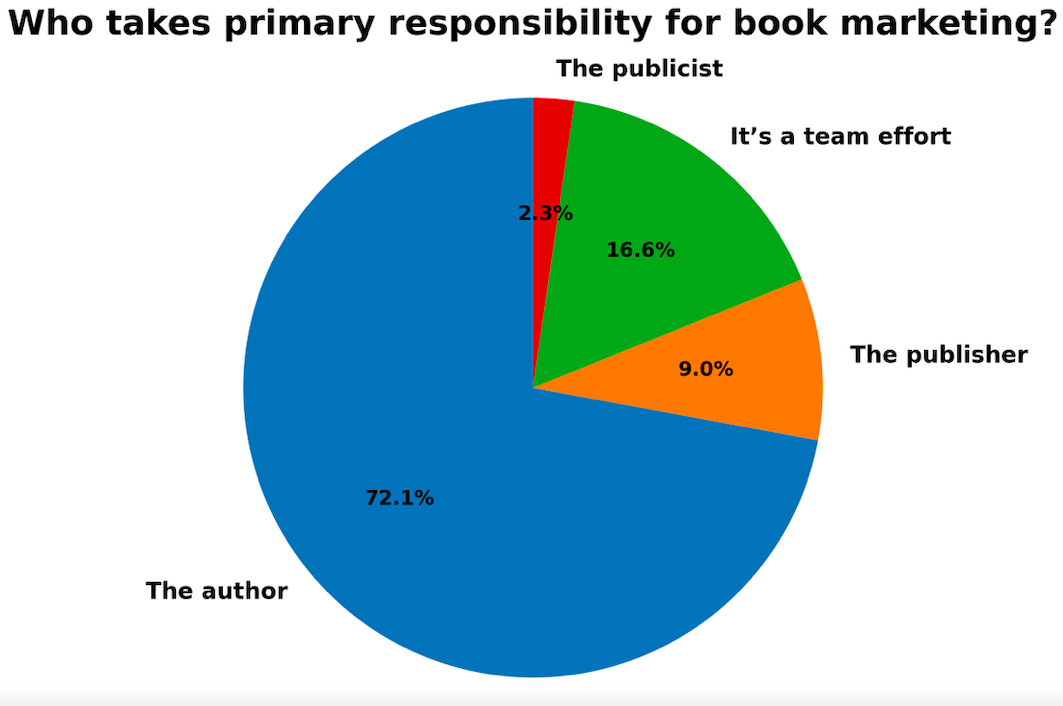
One of the clearest long-term trends revealed by the survey is the growing role authors play in marketing their own books. As we do each year, respondents were asked who takes primary responsibility for planning and executing book promotion efforts.
The results show a steady shift toward author-led marketing, with just a little over 11% of respondents reporting that either the publisher or the publicist did most of the work, and 16.6% declaring it a team effort.
Looking back at prior year’s surveys illustrates how this trend has developed.
| Year | Author responsible |
| 2022 | 61% |
| 2024 | 58% |
| 2025 | 63.2% |
| 2026 | 72.1% |
This shift reflects broader changes across the publishing ecosystem. While publishers continue to provide editorial support, distribution and publicity resources, authors are increasingly expected to contribute directly to marketing activities. These may include running advertising campaigns, engaging with readers on social media, building email lists and promoting new releases across multiple channels. For many writers today, publishing success requires mastering both storytelling and marketing.
The only silver lining may be that many of the solutions required to market books have never been easier to use.
Audiobooks: Rapid Sales Growth Meets Author Skepticism
Audiobooks are frequently described as one of the fastest-growing segments of the publishing industry. Major platforms report strong increases in listener engagement. Spotify, for example, has reported 36% year-over-year growth in audiobook listeners and 37% growth in listening hours.

These trends reflect broader changes in consumer behavior as streaming platforms and mobile devices make audio content easier to access than ever before. Yet the survey results reveal a notable disconnect between industry enthusiasm and author confidence.
In 2026, 55.8% of respondents publish audiobooks, but more revealing is how respondents evaluated the format from a sales perspective. When asked which format they trust most to generate revenue, the results were striking.
The trusted sales format by authors was the eBook, at 81.4%, followed by softcover at 18.6%.
Despite growing listener engagement, not a single respondent identified audiobooks as their most trusted book revenue channel.
Several factors may contribute to this gap, including royalty distributions. Audiobook production typically involves higher upfront costs than eBook publishing, including professional narration and audio engineering. Marketing tools for audiobooks are also less developed than those available for eBooks on major retail platforms. For many authors, audiobooks apparently represent a promising but still developing revenue stream.
eBooks and Softcover Print Anchor the Industry
Despite ongoing innovation in publishing formats, the survey shows that eBooks and print remain central to the publishing economy. Among respondents in 2026:
- 97.7% publish eBooks
- 95.3% publish softcover
- 55.8% publish audiobooks
- 34.9% publish hardcover
When asked which format inspires the most confidence for generating sales, the results overwhelmingly favored digital publishing. More than four out of five respondents selected eBooks as their most trusted revenue source.
This finding is particularly noteworthy given that industry analysts have suggested that eBook sales growth has slowed in recent years. Even if growth has stabilized, the format remains central to publishing due to its advantages. Low production costs, instant global distribution, integration with online retail algorithms and reader convenience are central to its popularity. In addition, print books continue to play an important complementary role, particularly in bookstores and retail environments, but digital publishing remains the economic backbone for many authors.
Where Books Are Sold
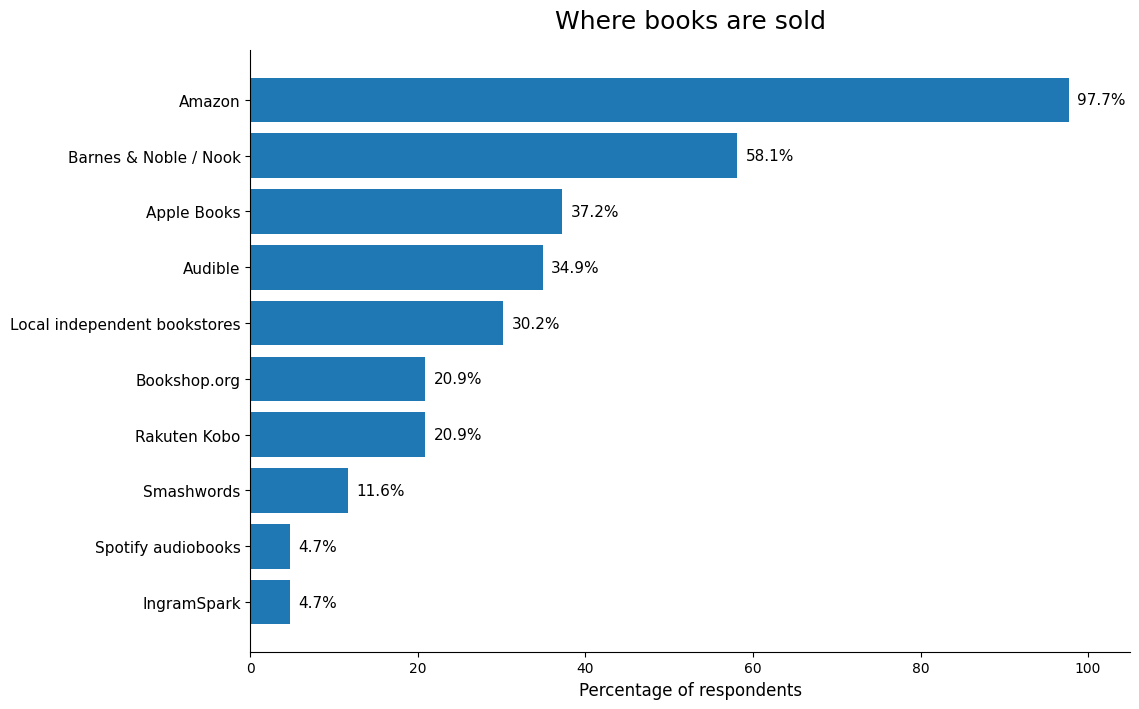
Books today reach readers through a diverse network of retail platforms. Survey respondents were asked to tick and/or write-in digital or non-digital platforms where they sell their books.
Amazon remains the dominant sales channel, with nearly universal participation among respondents. However, the data also shows that many authors and publishers are expanding beyond a single retailer. Multi-platform distribution strategies allow books to reach readers across numerous digital storefronts and physical retail channels. One notable finding involves Spotify’s audiobook platform. Although only 4.7% of respondents report distributing audiobooks through Spotify so far, the platform’s rapid growth in audiobook listening suggests it may represent an emerging opportunity for authors and publishers.
Barnes & Noble/Nook retain a significant foothold, significant gains were seen by Bookshop.org and Rakuten Kobo. Notably, 30.2% also sell in local independent bookstores. Once thought destined to become a bookselling giant, Apple/iBooks is still relatively small among the big names.
The following chart tells the story:
Pricing Strategies That Drive Discoverability
For the first time, the survey asked respondents to evaluate various book pricing strategies.
Most commonly cited strategies were, in order:
- Free promotions
- Discount campaigns
- Market-average pricing
These tactics are widely used in genre fiction to introduce readers to new series, stimulate early sales momentum and improve visibility in retail recommendation systems. Pricing promotions remain one of the most accessible tools authors can use to attract new readers. A strategy that respondents were least comfortable with was premium pricing.
Advertising Has Become a Core Book Marketing Tool
Another major shift revealed in the survey is the growing importance of advertising.
Respondents rated the importance of advertising as follows:
- 37.2% – Extremely important
- 27.9% – Very important
- 4% – Somewhat important
- 17.9% – Not very important
- 11.6% – Not important at all
Combined, roughly two-thirds of respondents now consider advertising a core component of their marketing strategy. As marketplaces become more crowded, advertising offers authors a reliable way to increase visibility and reach new audiences.
Digital Book Marketing Platforms
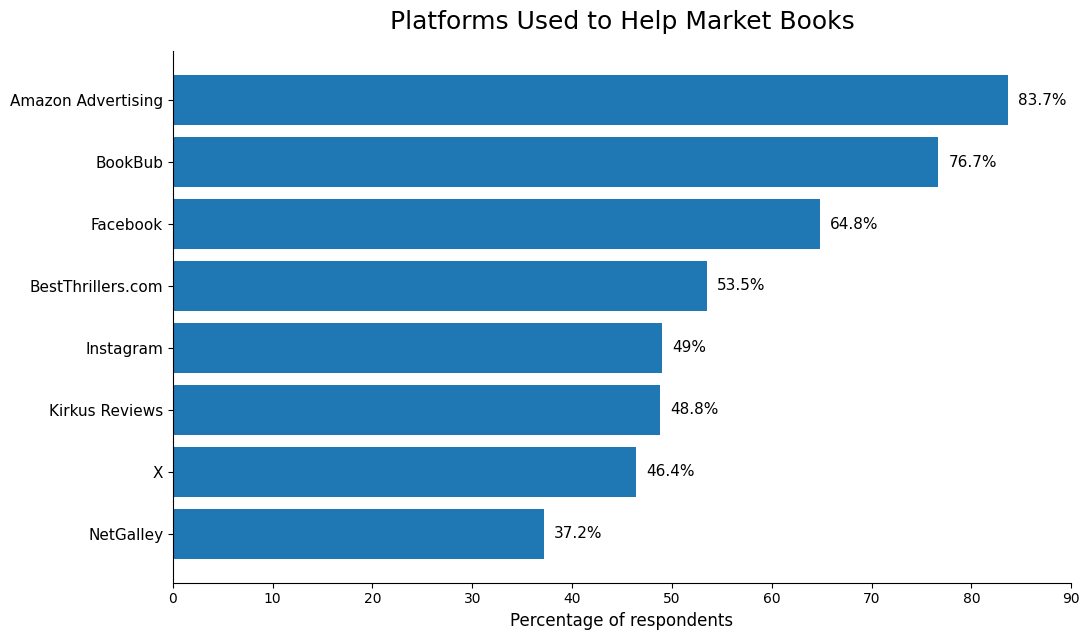
Respondents were asked to tick and/or write-in all platforms they had used to market their books, with choices ranging from all-in-one platforms like Amazon to specialty sites like NetGalley. The following chart indicates the top results. Although 24 unique platforms appeared in the results, most were below 5% in audience share.
Social Media Marketing Is Spreading Across Multiple Platforms
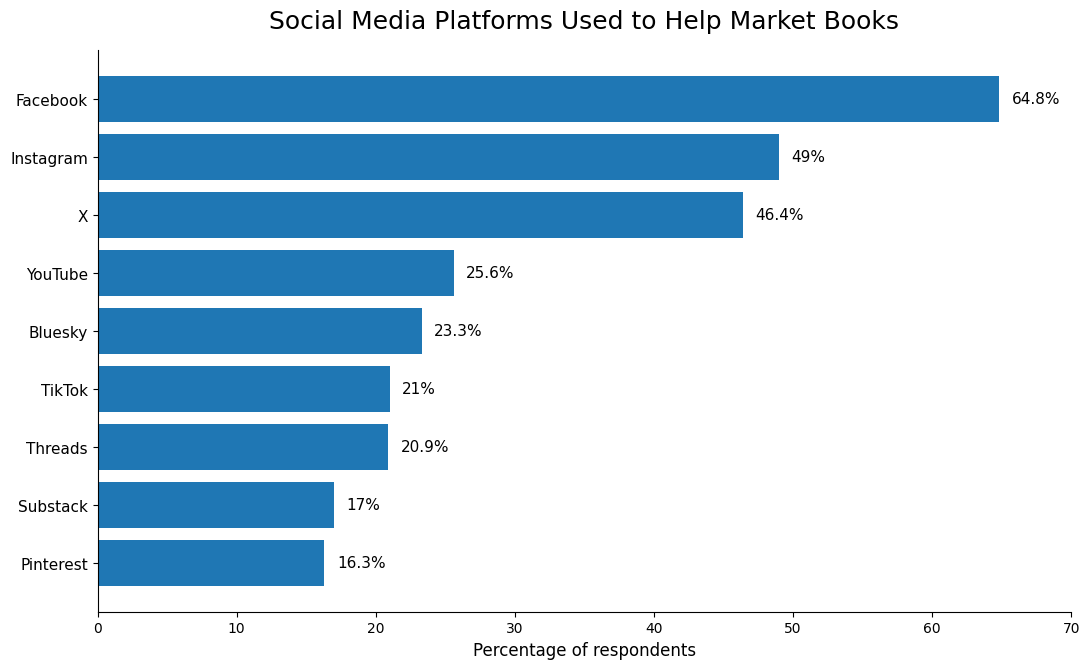
Social media remains an important marketing channel for authors and publishers, but the landscape is increasingly fragmented. Respondents were asked to tick and/or write-in all platforms they had used to market their books.
Among the results, TikTok is particularly notable. The BookTok community has generated more than 180 billion views, making it one of the most influential reader communities in modern publishing. Yet only 21% of respondents report actively using TikTok for marketing. This suggests that BookTok’s influence may be driven primarily by reader recommendations rather than author promotion. At the same time, the relatively low participation rate suggests that authors comfortable with video content may find significant opportunities on the platform.
The below chart indicates only those social platforms with signiicant audience share.
Reader Communities are Still Influential
Reader communities remain an important part of the book ecosystem. Despite predictions that newer platforms might challenge Goodreads’ dominance, the platform continues to maintain a significantly larger user base and author adoption.Goodreads alone reportedly has over 150 million members, making it one of the largest book-focused platforms in the world. 65.1% of respondents report using Goodreads, while just 5% report using StoryGraph, the platform that was heralded as GoodRead’s primary threat.
However, the survey suggests authors may view these communities as somewhat less central to their marketing strategies than in the past. Respondents rated their importance as follows:
- 44.2% – Somewhat important
- 11.6% – Very important
- 11.6% – Extremely important
- 18.6% – Not very important
- 14% – Not important at all
Book Awards Continue to Carry Weight
Book awards remain an important tool for gaining visibility and credibility. Respondents rated their importance as follows:
- 32.6% – Extremely important
- 25.6% – Very important
- 23.3% – Important
- 8% – Not important at all
Awards can help books attract media coverage, strengthen reputations and build trust with readers.
For many authors and publishers, awards remain an important component of long-term marketing strategies.
Coordinated Book Buys: A Divisive Book Marketing Strategy
For the second year in a row, the survey asked respondents about coordinated book purchases during launch windows. Responses were mixed:
- 36.2% – Somewhat important
- 35.1% – Not important at all
- 14% – Very important
- 12% – Extremely important
While some publishers and authors use coordinated purchases to boost early rankings, the strategy is not universally embraced. One reason may be that coordinated book buys require infrastructure that is too costly or unavailable to many. Others may disagree for ethical reasons, or because the juice is deemed to be simply not worth the squeeze.