
The Bottom Line: A relentless survival thriller with real bite. Melby shows us what happens when nature stops playing by the rules, and for once, a terrifying reptile nightmare feels like it could actually happen. Highly recommended.
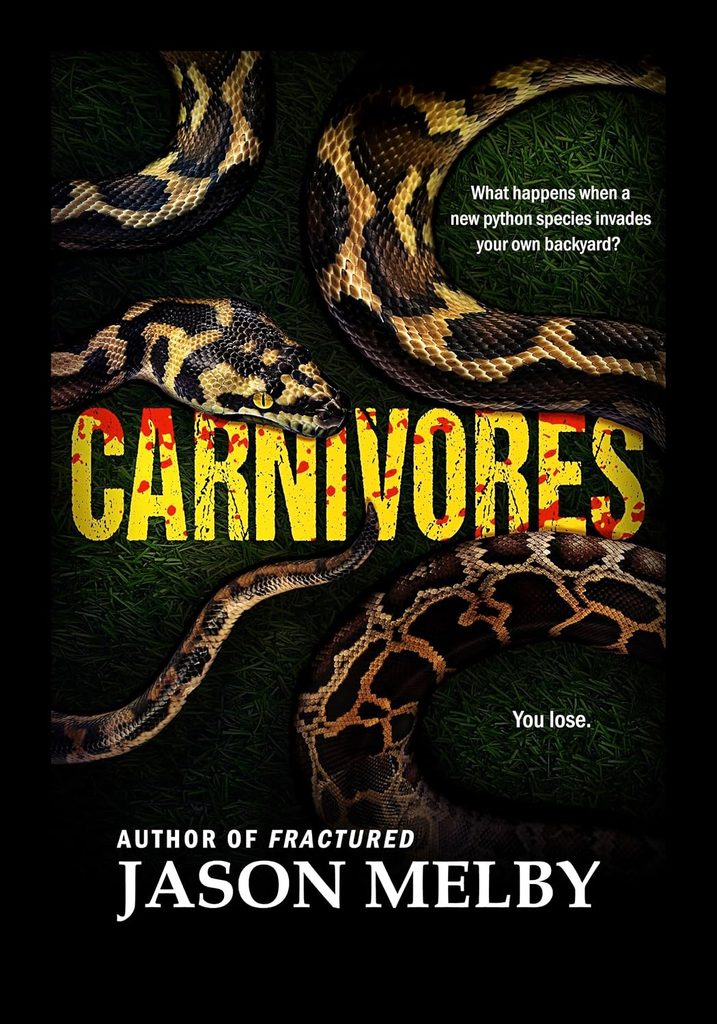
Carnivores opens as herpetology professor Christina Flannagan and teaching assistant Kyle Daily enter the Florida Everglades to recapture Henry, a tagged Burmese python used in her ongoing study of the invasive snake population. When Henry’s transmitter leads them toward a twenty-foot snake, Flannagan rejects the idea that her ten-foot specimen could have doubled in length in three months. The more troubling possibility is that the larger animal swallowed him, transmitter and all.
Author Jason Melby wastes little time in delivering the book’s first of many white-knuckled moments, as Flannagan beheads an eight-foot python just before it closes in on Kyle. Sensing more danger is afoot, they beat a hasty retreat back to their airboat, only to discover its captain dead inside another massive constrictor’s coils.
Melby shifts the action north to Palm Bay, where off-duty police officer Matt Matalski interrupts a convenience-store robbery. His intervention saves lives, but sends a wounded fugitive fleeing into an unfinished development known as the compound. From there, pets vanish, residents fail to return from routine outings, children discover an enormous shed skin, and speculation grows that a serial killer may be operating in the area. Melby creates an effective police procedural out of the authorities searching for a human pattern, while we all know that something very different is afoot.
In villain J. T. Barton, the boisterous president of a major development company, Melby has created an effective antagonist counterpart to the book’s reptiles. Barton recruits Flannagan after a massive python is discovered on his construction site, but his interest in science lasts only as long as it protects his investment. He consumes land, labour and public trust with the same indifference the snakes bring to their prey. Flannagan therefore faces an increasingly cold-tolerant python population and a businessman determined to manage the appearance of disaster rather than the disaster itself.
Readers familiar with Melby’s work, such as Psychopathic and Fractured, will recognize his interest in damaged people placed under immediate pressure. The difference here is scale. Rather than concentrating chiefly on a human predator, Carnivores morphs into a high-concept survival thriller capable of reaching a broad audience. However, unlike the countless books inspired by Michael Crichton’s iconic Jurassic Park, Melby’s story feels far more realistic. That’s thanks to the fact that the snakes are presented not as supernatural monsters but as efficient hunters able to detect heat, vibration and movement while remaining nearly invisible in water or vegetation. The payoff comes again and again, as in an early sequence following two teenagers who leave an unsuccessful fishing trip to experiment with firecrackers beside a canal. Melby turns an ordinary childhood afternoon into an expression of the book’s central theme: danger flourishes in the gap between what people assume they understand and what is actually waiting nearby.
As scientific evidence, police work, media fear and development politics converge, Melby delivers a genuinely startling enlargement of the threat. The large cast and technical passages make the book’s middle chapters dense, but the accumulation creates the convincing sensation of an entire neighbourhood being encircled. Its real engine is the physical vulnerability of people trapped in ordinary places that have become hostile, combined with the institutional failure to recognize the change in time. Carnivores is tense, graphic and difficult to put down once the grass begins to move.