
The Bottom Line: A timely, morally charged legal thriller for the ICE era, driven by one attorney’s refusal to look away.
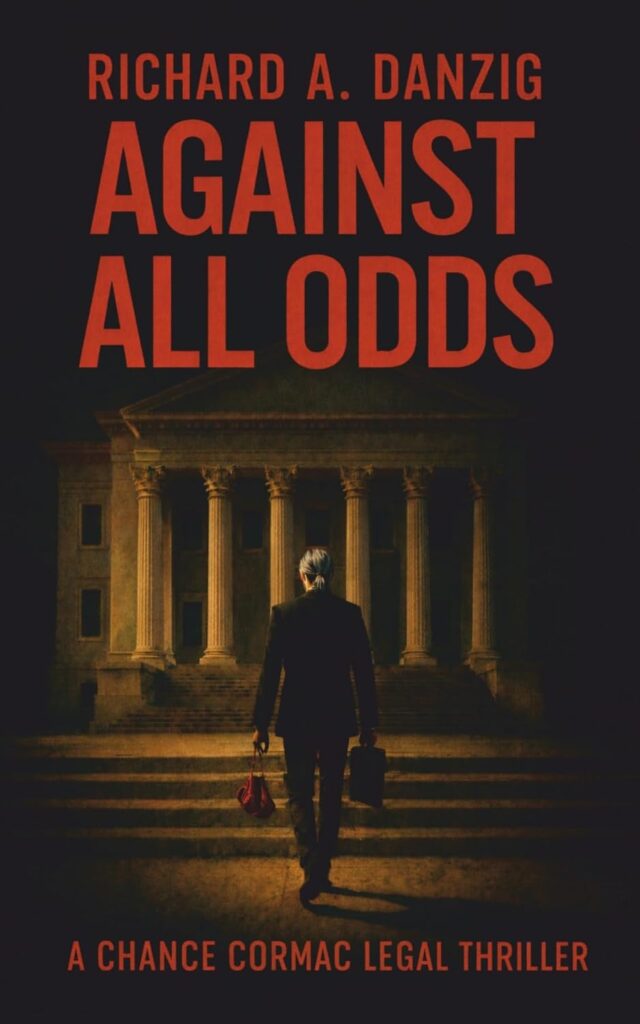
In Richard A. Danzig’s fourth Chance Cormac book, Against All Odds, the Brooklyn lawyer has stepped away from his practice amid a crisis of faith and embraced a timely new calling: traveling from courthouse to courthouse to represent immigrants held in detention.
The novel’s central case involves Dr. Lyla Abda, a Lebanese-born pediatrician and Yale fellow whose life has been shaped by medicine, faith, and service to starving children. After Danzig carefully establishes her childhood, education, and humanitarian vocation, she is seized outside Yale New Haven Children’s Hospital by masked men who claim her visa has been revoked for national-security reasons. The case puts Chance at risk almost immediately, not only because he is challenging a secretive and punitive detention apparatus, but because his own anger threatens to turn advocacy into self-sacrifice.
Across the series, Danzig has steadily widened Chance Cormac’s battlefield. Facts Are Stubborn Things moved from family law into international money laundering, Punch Line turned a personal-injury case into a fight over identity, speech, and institutional liability, and The Collectors expanded into international criminal defense, art fraud, and organ trafficking. Against All Odds feels like the broadest and most morally urgent extension of that pattern, shifting Chance’s fight from individual wrongdoing and criminal conspiracy toward the power of institutions themselves.
Much of the novel’s urgency comes from Danzig’s depiction of ICE’s growing power in America. The book presents immigration enforcement as a machinery of detention, secrecy, and fear that can reach from a hospital sidewalk to a federal courtroom and beyond. One of Danzig’s most compelling and charged early sequences comes in a Louisiana courtroom, where Chance confronts a judge, armed immigration officers, and the humiliation of a shackled client whose religious dignity has been stripped away. What follows is a tense legal and moral fight that carries Chance from federal courtrooms toward the threat of CECOT in El Salvador, with Danzig using habeas proceedings, venue battles, government evasions, and sudden reversals to keep the case unpredictable without losing sight of its human stakes.
Elsewhere, one of the series’ hallmarks is that Chance Cormac books don’t solely belong to Chance. Here, two characters in Chance’s orbit – veteran defense lawyer Frank Fogarty and Wendell “Justice” Holmes, the former detective who remains one of Chance’s closest allies – take on a separate criminal-defense matter involving Blaine Samuels and Kayce Carter, two arrogant former investment bankers accused of turning esports, crypto casinos, fake identities, and cheat software into a lucrative gambling operation. The connective tissue is that both cases are about rigged systems, and both ultimately ask what happens when the game is fixed and ordinary people are left to suffer the consequences.
Danzig brings back other recurring characters as well, including Sally McConnell, Chance’s former paralegal and first love, who anchors the book’s domestic drama. She is facing her husband James Stockton’s cancer while trying to protect her daughter Melody, whose life is complicated not only by grief and tennis pressure but by cyberbullying at school. Although the central case is clear enough for new readers to follow, Against All Odds is best approached as a true fourth installment rather than a stand-alone reset. Its emotional force depends heavily on the accumulated history among Chance, Sally, Melody, Justice, Damian, JR, and even Tort, all of whom give the new crisis its sense of consequence. Readers already invested in that circle will find the book especially rewarding, but even newcomers should appreciate the force with which Danzig turns a legal case into a test of conscience, loyalty, and institutional power.