
The Bottom Line: Irresistible. Before the Devil Knows pushes Dingle’s Gus Wheeler series into its darkest terrain yet, where religious terror and ritual murder collide.
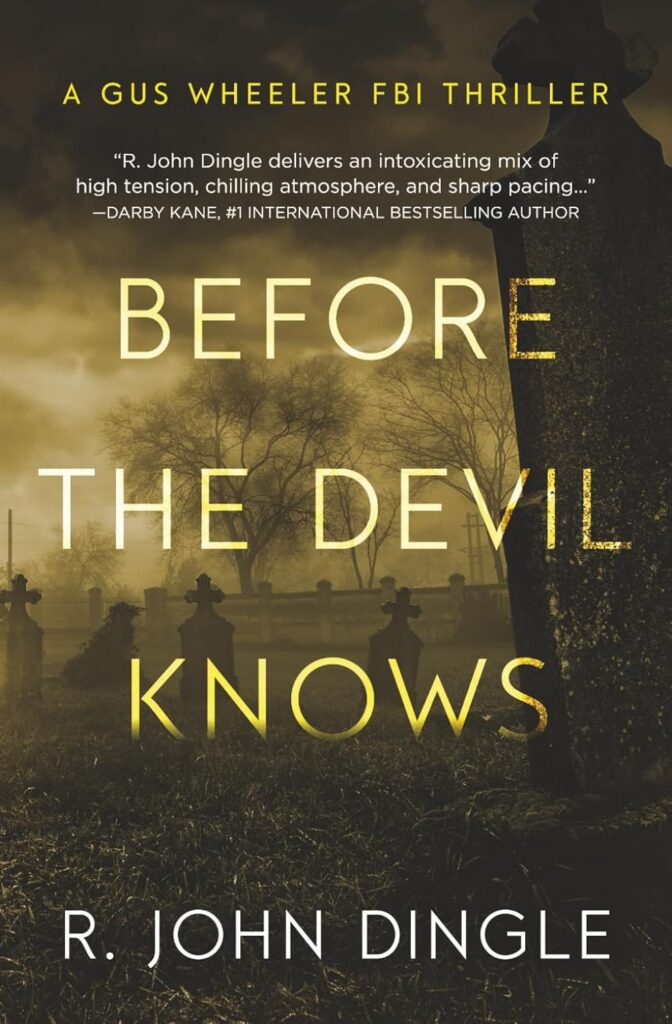
Before the Devil Knows opens in the Maine woods with the kind of betrayal that makes a book impossible to put down. Teenager Adam Carson is dragged from his bed, hooded, beaten and chained to a tree and surrounded by robed figures chanting scripture. He recognizes people in the circle, but the book’s first true horror lands when his own mother steps forward and casts the first stone.
By the time Adam’s disfigured body is later found in an unmarked grave with a lead cross laid across it, FBI agent Gus Wheeler and his partner Vanessa Lambert are facing a murder that already feels less like an isolated killing than a ritual judgment. A religious pamphlet left on the agents’ truck, with a passage highlighted inside, becomes one of the investigation’s first signs that someone may be communicating with them rather than merely watching them. The highlighted passage inside raises urgent questions: is someone trying to help Gus and Vanessa, expose the killers, or point them toward a truth the church wants buried? Or is the message more manipulative than helpful, steering them toward a particular interpretation of the murders—or toward a particular suspect?
Series fans know that Dingle has built the series around violent openings, contained communities and clues that point toward hidden histories or private moral systems. In Karma Never Sleeps, the murder trail wound back toward a funeral card and the old secrets of a seemingly tight-knit town. In Wings of Madness, the disappearances around Music Row drew Gus and Vanessa into a psychologically charged manhunt shaped by memory gaps, performance, and predation. Here, the case quickly develops into a religiously charged procedural. Gus and Vanessa learn that Adam may not be the first victim in this ritual pattern, and when his girlfriend Mary Philips disappears after trying desperately to reach him, the investigation gains both urgency and emotional shape.
Their work is made harder by the setting. Kingston and the surrounding towns are remote, suspicious of outsiders, and thinly served by law enforcement. The agents are not simply looking for evidence. They are trying to break into a closed world where privacy, fear, faith and local loyalty have fused into something difficult to penetrate. That deepens one of the series’ most reliable pleasures: watching Gus Wheeler think. Gus notices patterns in symbols, behavior, scripture and staging. A carved Bible verse near Adam’s grave. The same chalk blessing above more than one doorway. A hidden photograph of Adam and Mary outside a church. Every decoded symbol seems to clarify the case while also suggesting that the killers may be operating from a logic Gus and Vanessa do not yet fully understand.
Place has always mattered in this series, and northern Maine may be Dingle’s most ominous use of New England atmosphere yet. Here, the roads narrow, cell service fades, cemeteries sit at the edge of wilderness and the distance between houses feels like a form of concealment. The landscape is not supernatural, but it is powerful. Accordingly, the Slaves of the Sacred Heart of Jesus gives the novel its most memorable early setting. At first glance, the church’s rural retreat is framed as one where children and teenagers work fields, tend animals, attend services and live within a self-sustaining religious community. But when Gus and Vanessa meet Father Benedict and youth ministry director Matthew Fleming, the pastoral image darkens. Matthew’s contempt for Mary and for anyone he sees as impure is not hidden behind politeness, and Father Benedict’s calm doctrinal certainty makes the place feel more dangerous, not less.
Around the church, Dingle populates the novel with figures whose certainty is more unsettling than overt menace. Even smaller presences such as the motel owner, guarded relatives, silent parishioners and local witnesses, contribute to the feeling of a region where everyone knows something and few are willing to say it plainly.
Their view of moral failure is chillingly absolute. One of the book’s sharpest effects is the way it turns familiar rural details—church signs, old cemeteries, farm work, motel rooms, logging roads—into pieces of a larger design.
This is also where Before the Devil Knows most clearly departs from the earlier books’ emotional register. Karma Never Sleeps carried the pleasures of a small-town murder mystery, with social entanglements, gossip, infidelity, and a killer hidden behind an attractive civic veneer. Wings of Madness moved into a more intense psychological space, using the music scene and the fear of lost time to complicate guilt and suspicion. Before the Devil Knows is colder. Its suspense comes less from social gamesmanship or unstable memory than from the terrifying confidence of people who believe punishment can be holy. The result is still a procedural, but one with the feel of a closed-community thriller steeped in ritual dread.
Vanessa Lambert remains an essential counterweight. In earlier entries, she grounded Gus’s exacting habits with sardonic wit and streetwise pragmatism; here, that wit becomes even more necessary. The subject matter is grim, the landscape isolating, and the church’s moral certainty increasingly oppressive. Vanessa’s impatience, humor, and instinctive suspicion keep the book from becoming airless. Her rapport with Gus is relaxed without being casual and affectionate without turning sentimental. They bicker, joke, read each other’s silences, and move through danger with the practiced rhythm of partners who understand how the other thinks.
The supporting cast adds useful friction. Sheriff Carl Roberts is cooperative but clearly facing a case beyond normal rural policing. Deputy Tim Gorham understands the local terrain and the local temperament, giving the investigation access it might otherwise lack. Professor Ward Simmons gives the religious material intellectual ballast without turning the story into a lecture.
Before the Devil Knows extends the Gus Wheeler series by carrying its strengths into more provocative territory. But this case gives Gus and Vanessa a more hostile test, forcing the agents to interpret a belief system as much as a crime scene.
The book may resonate with readers fascinated by cases like that of so-called doomsday mom Lori Vallow Daybell’s, where extreme belief, family betrayal, and claims of divine certainty become inseparable from violence. New readers can enter the series here without feeling lost, while returning readers will recognize a book that pushes its leads to the very edge.