
The Bottom Line: A wildly imaginative archeology thriller that makes Greek myth feel new and dangerous.
Ox Devere’s third Ridley Samaras thriller has the kind of premise that sells itself: what if the myth of Perseus and Medusa was not myth at all?
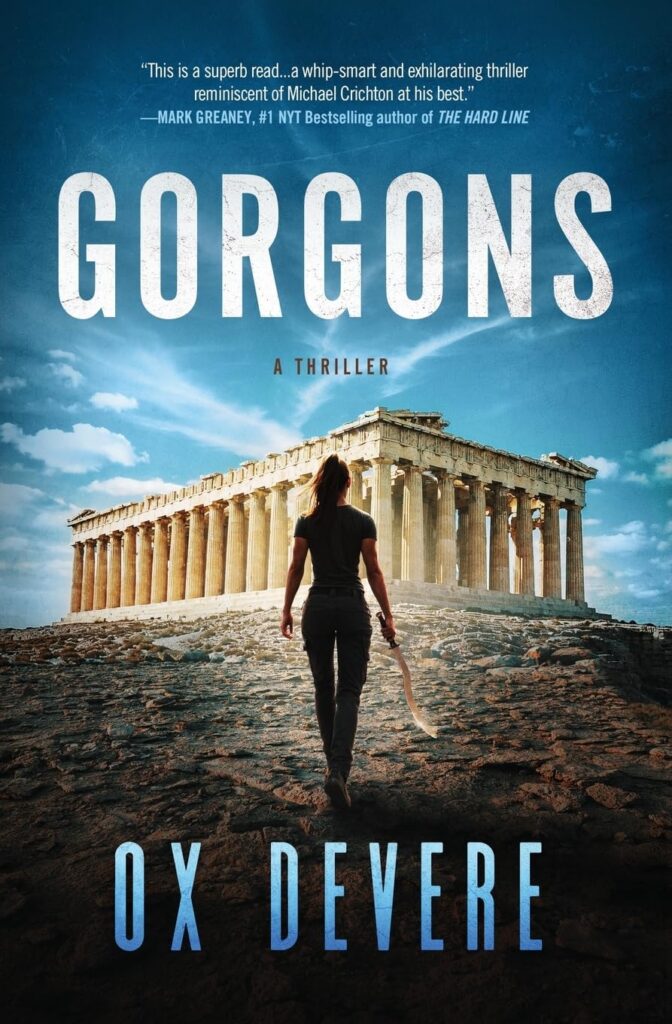
On a sun-blasted dig site above the Aegean, Gorgons wastes no time turning archaeology into danger. The breakthrough comes when Dr. Nasrin Aslani and her father, Jamshid, uncover an ancient carved stone tablet whose message appears to pull Medusa out of myth and into history. What should be a career-defining discovery becomes something stranger and deadlier. Nasrin is an Iranian dissident as well as an archaeologist, and the global attention surrounding the find places her squarely back in the sights of a regime that has already driven her into exile. By the time CIA operative Ridley Samaras is sent to Greece, the question is no longer whether the Aslanis have found something important. It is whether they will live long enough to understand it.
From that irresistible hook, Gorgons builds a fast-moving chase through Greek antiquity, diplomatic security, Iranian threat networks, and the shadowy mandate of Osprey, the covert CIA unit that handles the world’s strangest problems. Booker Douglas, Ridley’s boss, recognizes that the tablet may point to the mythic tools and weapons used to slay Medusa, while State Department agent Gabe Tolkin has a simpler brief: keep Nasrin and Jamshid alive as professional killers close in across the Mediterranean.
That clash of priorities gives the book its early spark. Ridley wants the truth. Gabe wants control. Nasrin wants the discovery. And every choice makes them more visible.
The novel also gets considerably larger and more dangerous as it goes. What begins in the Greek islands soon pushes beyond Greece into Egypt, Morocco, Spain, and Italy, with each stop adding a different texture to the hunt: tombs, reefs, old-world cities, criminal power brokers, volcanic terrain and increasingly direct brushes with the impossible. By the back half, the book has shifted into full globe-trotting thriller mode, complete with betrayals, casualties, hostage stakes and a third act that trades archaeological intrigue for something more explosive and emotionally consequential. Best of all is the Mount Etna endgame, where Devere turns the relic hunt into a volcanic rescue sequence that gives the book the scale its premise deserves.
Across Rage of the Jinn, The Devil’s Eye, and now Gorgons, Devere has carved out a lively corner of the supernatural thriller: ancient objects, buried texts, dangerous believers, and modern intelligence operatives trying to prevent history from becoming a weapon. This installment pushes that formula into especially fertile territory. Greek myth gives the novel an immediately recognizable frame, but Devere is more interested in complication than simple spectacle. Medusa is not merely a monster to be name-checked. Her story raises questions about violence, memory, gender, and who gets to define the official version of events. The same is true of Nasrin’s political life.
While Ridley remains the series’ strongest asset, the supporting cast gives Gorgons emotional pull. Nasrin Aslani’s refusal to retreat is both admirable and maddening, which is exactly why she works. Jamshid brings warmth, restraint, and scholarly gravity, while Gabe gives the book a welcome dose of friction. His skepticism keeps the story grounded even as the clues become more impossible.
The settings are just as important. Greece gives the book its mythic foundation, but the story’s momentum comes from how quickly the hunt expands across the Mediterranean and beyond: from Egyptian antiquity to North African waters, Spanish streets, Italian criminal circles, and finally a volcanic endgame where the supernatural stakes can no longer be treated as theoretical. Overall, Gorgons delivers a dangerous artifact trail, a volatile political backdrop, a heroine worth following, and a final act that keeps widening the scale in blockbuster fashion.