The Bottom Line: A must-read medical thriller about the thin line between innovation and exploitation. Perfect for fans of Blake Crouch and Michael Crichton.
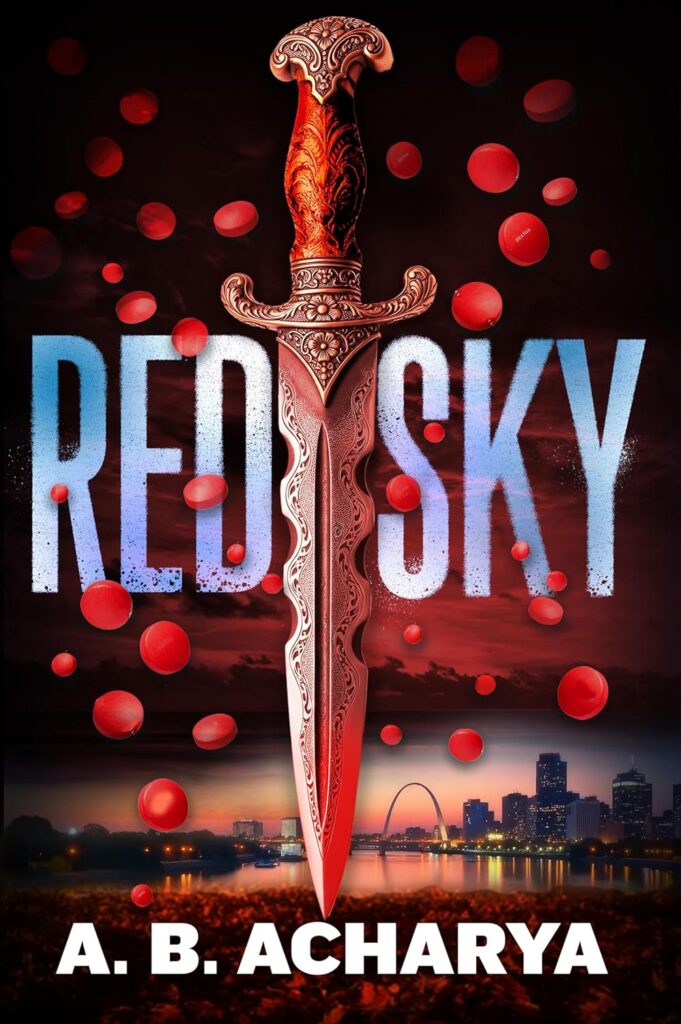
Red Sky opens with pharmacology researcher Narin Roy writing a confession in a St. Louis police interrogation room. Author A.B. Acharya withholds the precise nature of the crime, but, tantalizingly, casts him as an unreliable narrator by revealing that the confession comes under the influence of Red Sky, a drug that nearly killed him.
We soon learn that Narin has spent years in Chicago researching Red Sky, a street drug that can produce euphoria, hallucinations and mental clarity, but can also trigger a rare and horrifying switch in which users may turn violently against themselves or others. Narin believes he has found a way to prevent that reaction, a discovery that could make the drug medically useful and commercially valuable.
Unfortunately, his research career is falling apart. Narin believes his research mentor, Dr. Cohen, has helped another scientist take credit for work that should have been his, his funding has fallen through, and a crucial job interview in St. Louis soon ends in humiliation. By the time Harvester Pharmaceuticals offers him a place in its Red Sky program, Narin is grasping at the only future still open to him. To keep it, he must help turn a dangerous street drug into a controlled medical breakthrough while navigating a company full of secrets and people ready to exploit his hunger for recognition. Narin wants prestige, proof and a future. Harvester offers all three, along with access to money, equipment and Sophie Whitely, the grieving artist who quickly becomes the center of his romantic imagination.
What begins as a desperate job opportunity becomes a struggle involving uses of neuroscience far darker than public health. Acharya keeps the suspense close to Narin’s unstable perspective, which gives the novel its edge. How much of what we learn is distorted by the mind telling the story? And what crime has brought Narin here? The answer to that question is held well into the book’s last act.
Acharya, a neurologist, writes the medical and pharmacological material with an insider’s confidence, but he does not let the detail sit inertly on the page. Receptors, drug effects and lab protocols matter because they shape the choices characters make and the harms they are willing to excuse. Maru, resentful and watchful, turns Harvester’s polished surface into hostile territory. Sophie is vulnerable, artistic and haunted by loss, but Narin’s view of her is so charged with longing that tenderness and possession are never far apart. The novel recognizes the promise of neuroscience, but never lets us forget what happens when discovery is driven by greed, ambition and power instead of conscience.