
The Bottom Line: RISE proves this series is only getting better: darker, smarter, and more dangerous at every turn.
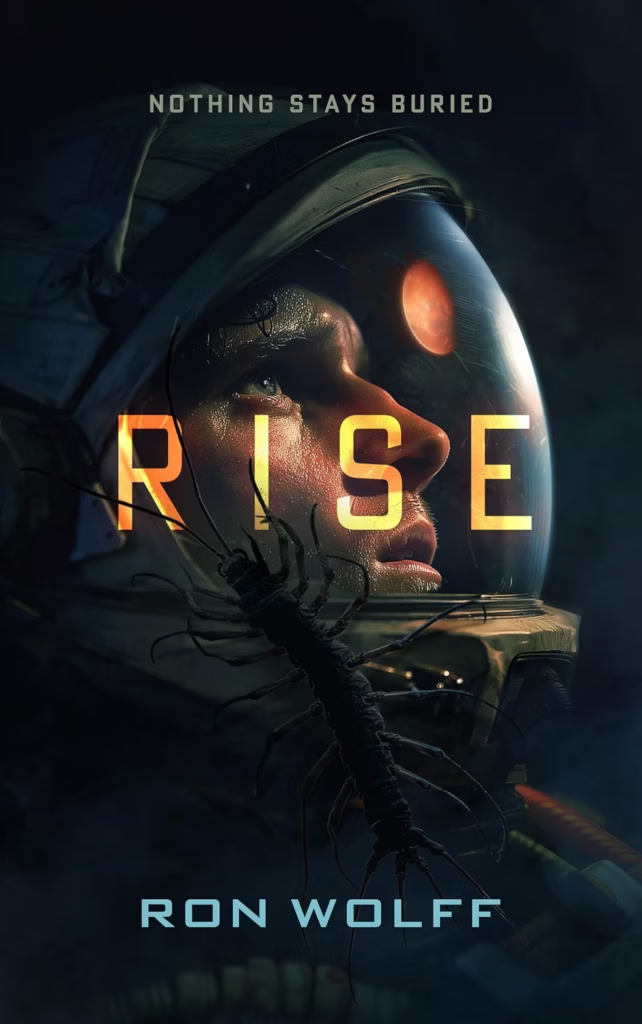
The second book in Ron Wolff’s Colony series, RISE, returns to Mars through the first-person narration of Adam Flynn, the first and only human born on the planet. Months after a massacre at Hellas Station, Adam and four other teenagers are barely keeping the damaged colony running while waiting for help from Earth.
A new expedition arrives carrying Commander Aisha Redmond, a doctor, a security officer, a pilot, a documentary team and four gifted young interns. Its members know that Hellas suffered a mass-casualty disaster and that five teenagers survived, but they have been briefed to treat the reported attack by indigenous creatures as an unverified claim. The surviving footage is fragmentary, and there are no specimens because Adam and his friends killed the hive’s queen, then burned the creatures and whatever human remains they could recover because they feared something might come back to life. Wolff turns that absence of evidence into a dangerous credibility gap that puts the entire crew in danger.
One of Wolff’s greatest additions to the series is the introduction of Dr. Park, a conscientious, clinically minded medical officer who approaches the survivors with careful questions, studies their symptoms and insists on explanations she can support with evidence. That discipline initially blinds her to a threat outside her experience. Her scepticism does more than wound the survivors. It delays precautions, encourages newcomers to disregard Adam’s warnings and leaves the colony vulnerable when signs of the infestation begin appearing again.
Wolff’s sharpest source of suspense is therefore not simply that the creatures may have returned, but that the people best equipped to recognise the danger are the least likely to be believed. Star Trek universe fans may recognise Vulcan-like tendencies in Dr. Park’s controlled reasoning and insistence on evidence, but Wolff avoids reducing her to a rigid sceptic. Once the facts exceed the limits of her clinical framework, she has the intellectual honesty to revise her judgment and the courage to act.
Meanwhile, Adam’s need for control becomes painfully clear when a documentarian insists on entering a sealed wing, ignores his safety instructions and falls through a damaged wall into a cloud of pale, web-like residue. When she later dies and the same material appears in vents and living quarters, the newcomers continue searching for familiar explanations. Wolff uses their refusal to listen as more than an obstacle to the action: it becomes another powerful mechanism by which danger is allowed to spread. Respirators, temperature settings, ventilation shafts and pressure seals carry as much suspense as the creatures themselves.
Wolff keeps the prose direct and accessible while allowing traumatic memories to intrude on the practical business of survival. Along the way, Wolff sharpens one of the book’s strongest themes: survivors do not merely have to endure catastrophe. They must also contend with outsiders who package it, diagnose it and reinterpret it.
The returning young cast remains a major reason the sequel works. Scarlett’s systems expertise and guarded loyalty make her a natural counterweight to Adam, while Isaac retreats into calculations, Danny uses humour to steady the group, and Constance brings disciplined practicality. Scarlett’s estranged brother Ethan arrives with the expedition, bringing unresolved family anger into an already unstable situation. Among the adults, pilot Mace Kittredge distinguishes himself by listening without condescension, while Commander Aisha Redmond combines authority with grief and motives that are not always easy to read.
The novel’s latter half delivers its surprises with considerably more force than a routine sequence of monster attacks. Earlier gestures, private obsessions and apparently reasonable decisions acquire darker significance as the scale of the crisis grows. Just as importantly, the suspense remains tied to Adam’s emotional struggle with responsibility, grief and the dangerous temptation to believe that the dead may not be entirely gone.
For those who enjoyed Colony’s mixture of Martian survival, youthful ingenuity and escalating alien danger, this is a worthy follow-up. It’s even more psychologically layered, more suspicious of authority and willing to push its surviving characters into harsher territory. RISE does not merely reopen the nightmare. It also asks who benefits when nobody believes it was real.