
The Bottom Line: A big-hearted YA novel that transforms fear and family fracture into something thrilling, strange and beautiful.
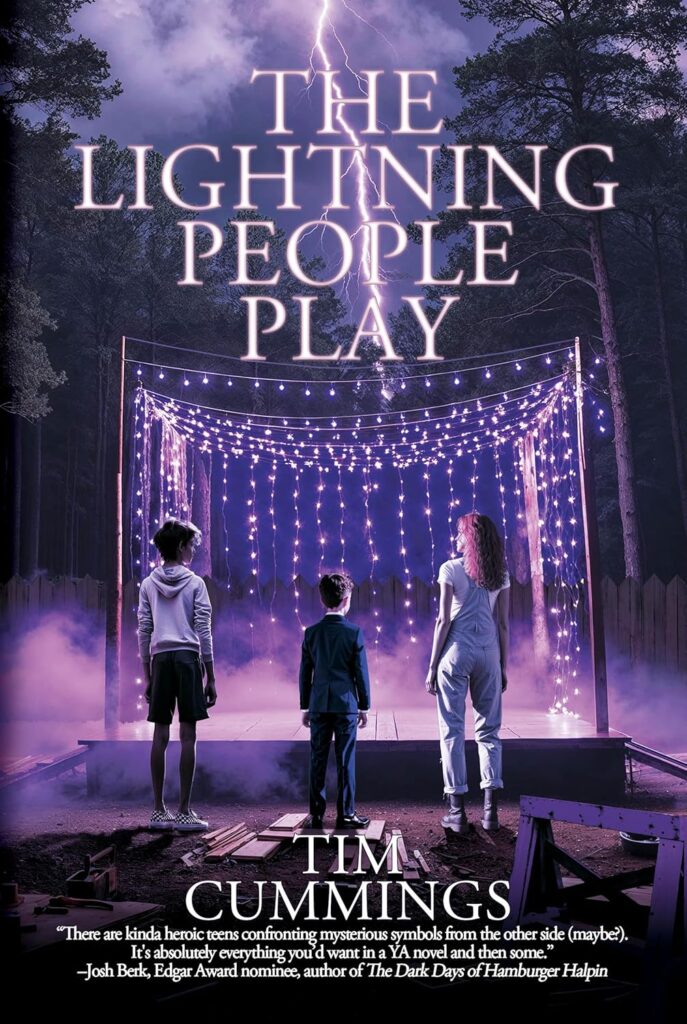
Kirby Daniel Renton’s family has been destabilized by the departure of one of his fathers, who he calls Pop. Kirby is convinced that his younger brother Baxter’s seizures are the result of Pop’s disappearance, reading the illness through the raw logic of grief rather than medicine. Curiously, during his seizures, Baxter claims to see mysterious figures he calls the “lightning people.” Set in Weirville, on the border between Pennsylvania and Ohio, author Tim Cummings sets such an episode in a carnival sequence, in which spectacle, flashing light, and medical danger converge, giving the story its first true jolt. Complete with a homophobic insult, Cummings creates an irresistible tone that is equal parts vivid, funny, and edged with menace.
Kirby, desperate to decode the symbols his brother draws after seizures, soon lands on theatre as a way to raise the money. Kirby’s investigation unfolds not through police work or clue gathering in the conventional sense, but through rehearsal rooms, backyard staging, school corridors, and the charged imaginative space between illness and performance.
While the plot is enticing enough, including satisfying revelations about the mysteries set up in the opening chapters, Kirby’s voice is the books’ defining feature. He is acerbic, theatrical, wounded and compulsively observant, and Cummings uses that sensibility to give the narrative both comic velocity and emotional intricacy. Kirby doesn’t simply narrate events. He instead sorts, colors, frames, and performs them. His mind is always arranging the world, which makes him an especially compelling guide through a story about phenomena that resist arrangement. In that respect, the book’s tension is psychological as much as suspense-driven. Kirby wants answers, but he also wants control, and the novel understands how often those desires are really the same thing.
Meanwhile, Baxter is strange, funny and quietly authoritative in ways that deepen the novel’s central mystery. Ellie and Rockford, Kirby’s closest collaborators, bring warmth and momentum, while the theatre mentor Krasinski helps the book explore art not as ornament but as discipline, refuge, and argument. Even the town itself, with its curated surfaces, carnival grotesquerie, and surrounding woods, contributes to the sense that the everyday world is only barely containing something more volatile underneath.
Cummings has created a winning combination of supernatural mystery, family drama and YA thriller wrapped into one. But at its core, the book is about the terror of not understanding what happened to someone you cannot bear to lose. Cummings honors fear while still making room for awe.