
The Bottom Line: A bruising neo-western crime thriller where greed, murder and frontier justice collide in rural Alaska. Perfect for fans of Taylor Sheridan and C.J. Box.
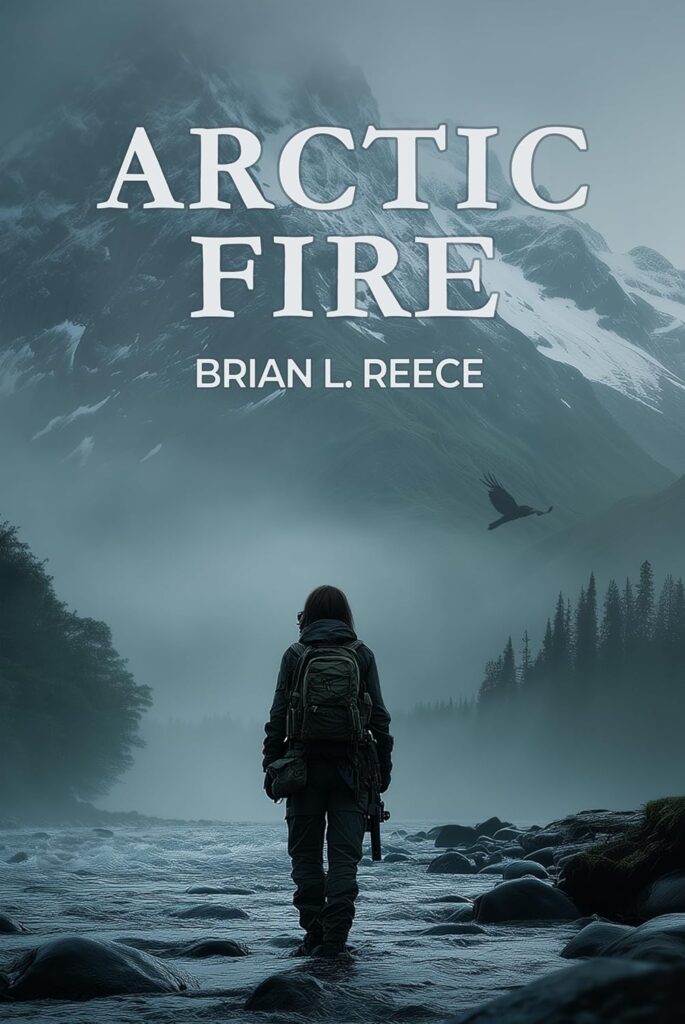
Arctic Fire opens with Major Zoe Nichols standing between armed United States Marines and Afghan villagers after a weapons-cache discovery turns into a standoff. Ordered from afar to seize the weapons, Zoe instead removes her helmet and body armor, lowers the temperature through sheer command presence, and persuades the village elder to stand down before the standoff becomes a firefight.
Years later, Zoe is barely holding herself together in Eagle Ferry, Alaska. She’s working a dead-end Bureau of Land Management job while grief, whiskey and survivor’s guilt hollow out what remains of her old discipline. Zoe’s collapse into alcoholism, trauma and denial comes after her husband and young daughter are killed in a car crash while she is deployed overseas. The last thing she wants is another fight, but one finds her anyhow.
MB Oil and Gas, led by Sebastian Fisher, needs access to Ozark Valley for a major natural-gas project. The land lottery has already been rigged for Fisher, with another BLM employee paid to cheat on his behalf. When Zoe is sent instead, she unwittingly draws the name of Heller Mason, a patriarch whose family has lived in the valley for generations. Walking away would leave the Masons exposed to Fisher’s money, lawyers and mercenaries. Staying makes Zoe a target.
Make no mistake – this isn’t a paper conflict. Author Brian L. Reece makes clear early on that Fisher’s empire is prepared to cheat, intimidate and even kill to get the land it wants. Standing in their way is Zoe, whose military experience makes her formidable even as guilt and self-punishment leave her dangerously unstable. The surrounding characters sharpen that conflict. Daniel Reeves, a disgraced journalist chasing the truth about Fisher’s company, brings investigative tension and a different kind of desperation to the story. Heller and Sarah Mason give Ozark Valley human weight, making the land far more than a piece of disputed infrastructure. Urso, Fisher’s scarred enforcer, embodies the violence that corporate language keeps at a distance.
The Alaskan setting is central to the book’s identity. Eagle Ferry is isolated enough for corruption to flourish and exposed enough that every threat feels physical. Snow, distance, rivers, mountains and weather are not merely decorative elements. They shape what characters can do, how quickly help can arrive, and how much the wilderness will forgive. This is where the novel’s neo-Western noir character emerges most clearly. Its world is modern, with permits, shell companies, private security and energy politics, but its conflicts are far more elemental.
As in Reece’s earlier novel Stealing Stealth, Arctic Fire is alert to the way institutions can fail under the weight of caution, corruption or self-protection, leaving people to act where systems hesitate. In Stealing Stealth, that failure plays out through intelligence agencies slowed by procedure and rivalry. In Arctic Fire, it appears in compromised land offices, pressured local law enforcement, and public processes vulnerable to private money. The setting has changed from international espionage to Alaska’s neo-Western frontier, but Reece’s interest remains fixed on what happens when official authority loses moral authority. All the while, the novel wisely keeps its emotional focus on Zoe, whose struggle to face the past gives the external conflict its moral center. The result is a dark, character-driven thriller that works on every level.