
The Bottom Line: Fast, cinematic and potent, Project Copenhagen goes down like a shot of aquavit on a frigid Scandinavian night.
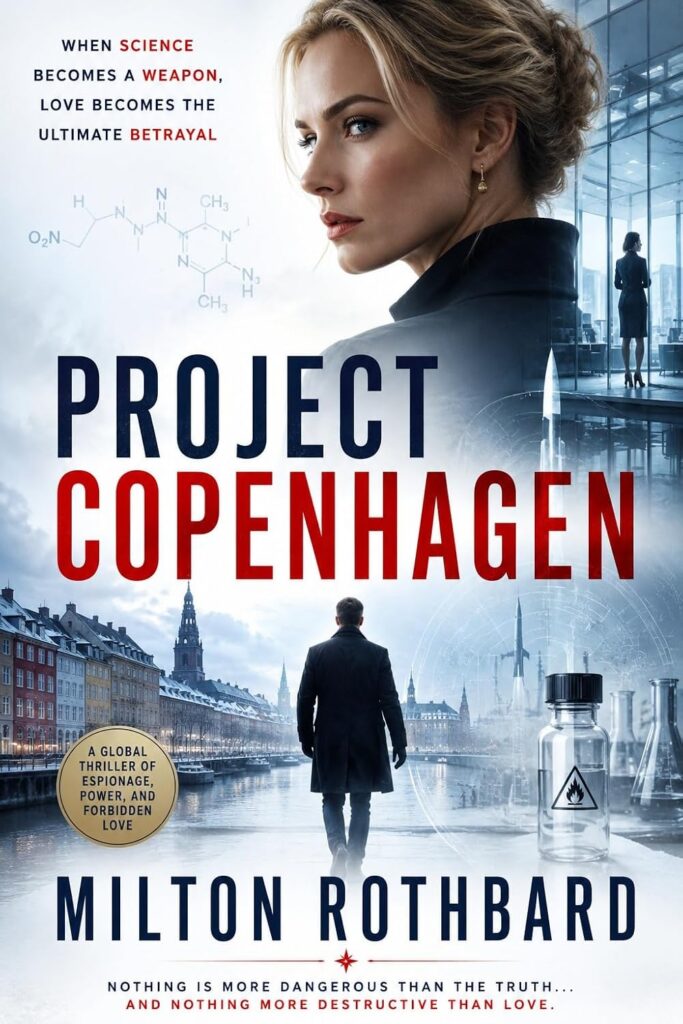
In Project Copenhagen, Italian chemical engineer Giordano Paoletti arrives in Denmark to work for København Biotek, a Copenhagen biotechnology company ostensibly pursuing an agricultural breakthrough. His assignment is to refine a compound that could improve farming, but the mathematics quickly contradicts the premise. Its reaction produces unnatural amounts of energy, behaves far more like fuel than fertilizer, and increasingly points toward missile technology disguised as agricultural research.
As Giordano begins to understand what he may have been recruited to complete, a warning originating with Chinese intelligence alerts CIA chemist Angela Crawford and field operative Robert Garnett to a covert weapons program in Denmark. Their off-the-books investigation leads them toward København Biotek and its formidable CEO, former Danish intelligence officer Freja Lindstrom, whose involvement in the project is complicated further where professional suspicion collides with a dangerous attraction between her and Robert.
In terms of style, the third installment in Milton Rothbard’sThrillers Saga feels exceptionally well matched to Copenhagen’s legendary minimalism. Rothbard builds an intentional artistic echo with short chapters, clipped paragraphs and deliberately lean description. Glass offices, immaculate interiors, frozen canals and snow-covered streets recur as visual motifs. It’s the exact opposite of cluttered old-world romance, and that makes it feel fresh.
Rothbard instead makes it cool, geometric and controlled, then places increasingly unruly human motives inside it. Even the novel’s compact length feels part of that aesthetic. The prose is designed for speed rather than ornament.
In Giordano, Rothbard has created a character that gives the book both its scientific credibility and its moral center. Giordano’s predicament gives the story its cleanest and most compelling stakes. He has not simply stumbled upon someone else’s secret weapon. His particular expertise is required to bring the technology closer to completion. If he follows instructions, he risks becoming the scientist who perfects missile technology disguised as agricultural research, potentially shifting the strategic balance between nations. If he refuses, he must defy the powerful people who recruited him, inside a heavily secured organization where cameras track movements and intelligence connections reach beyond corporate walls.
Beneath the espionage machinery lies a persistent argument about responsibility. Giordano begins with faith in the neutrality of equations, only to discover that accurate science can become morally indefensible when someone else determines its purpose. Freja approaches the same problem from the world of intelligence, where secrecy, obedience and national interest can make dubious actions seem professionally necessary. Robert introduces the book’s most intimate variation on that theme: he is sent to investigate a conspiracy in which Freja is implicated, while she must decide what loyalty means when the man attracting her is also investigating her.
The supporting cast keeps those loyalties fluid. Angela’s value lies not only in being Robert’s operational partner but also in possessing the scientific expertise necessary to understand what Giordano is seeing. Her arrival at København Biotek introduces both investigative pressure and personal friction. Harrison is deployed economically, functioning less as a conventional handler than as the experienced strategist who recognizes when official systems become liabilities.
The book continues to measure its largest questions through individual choices: what a scientist owes the world once innovation becomes dangerous, what an operative owes conscience when institutions demand obedience, and whether intimacy can survive when truth itself is classified.
Although it is the third Thrillers Saga book, Project Copenhagen can be enjoyed as a standalone. Compact enough to finish on a flight, Project Copenhagen delivers an impressive amount of international intrigue in a remarkably compact package, without overstaying its welcome.