
The Bottom Line: A stellar swamp-country legal thriller that turns one man’s murder into a reckoning with generations of injustice
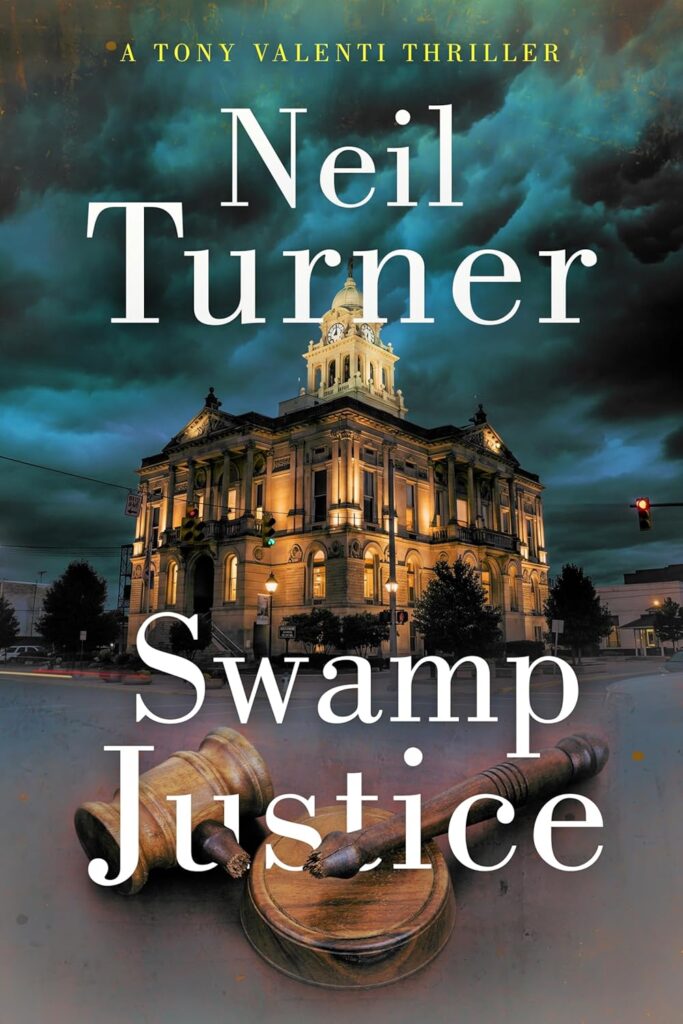
As Swamp Justice opens, Chicago-area attorney Tony Valenti is shocked by the news that the father of one of his investigators has been killed in what local authorities are calling a hit-and-run. But as Valenti gradually learns, the official story is almost too tidy to survive first contact with the facts. The county coroner sees no reason for an autopsy. Fish’s computer is missing. And the work that brought him to this small town was not harmless academic housekeeping, but a renewed investigation into land that the Pishukchi Nation believes was stolen from them generations earlier.
Down in Mississippi, Tony is less a fish out of water than a solvent introduced into a sealed system. Tony, who narrates the novel from his point of view, lends the book a blunt, funny and bruisingly affectionate voice. His humor is dry, his instincts are sharp, and his irritation at official evasions gives the book much of its forward motion. He is a genre lead built less around glamour than around moral persistence, the kind of lawyer who understands that procedure can be either a tool of justice or a polished excuse for doing nothing. Here, Tony’s first challenge is not simply to find evidence, but to determine whether the institutions meant to preserve it can be trusted at all.
In this, the 10th entry in Neil Turner’s Tony Valenti series, Turner has much to say about the persistence of stolen land as a living political fact, not a closed chapter of history, and the ease with which local institutions can be bent to preserve the original theft. Accordingly, the supporting cast gives Swamp Justice a wider emotional and political range than a simple revenge investigation would allow. Fish’s daughter, Chepi, is wounded but not helpless, a gifted hacker with a stubborn independence and a complicated relationship to the heritage her father spent his life studying. What begins as an act of concern for a friend soon becomes something larger. Clay Fish had been helping Chief Opah Homa revisit a dispute involving the Gareau family, whose power in this corner of Mississippi is tied to land, oil, local office, and a history that has never really receded. Chief Homa brings authority, historical memory, and a clear-eyed understanding of what her people are up against. Most intriguing is Harper Baudry, the local county attorney who belongs by birth to one of the region’s ruling families but is increasingly uneasy with the order that family represents. She is the insider who knows exactly how power moves behind closed doors.
Turner’s Mississippi is a cinematic network of courthouses, tribal offices, family estates, back roads, diners, and private property lines that carry implicit threats. One of the book’s most cinematic early sequences sends Tony down a rain-lashed Mississippi back road to meet Harper Baudry at a decaying hunting shack, where she reveals that the prime suspect’s distinctive car was supposedly reported stolen just before Clay Fish was killed. The meeting turns from uneasy briefing to moral crossroads as Harper admits how compromised the local system is and asks Tony to help her prosecute a case she cannot carry alone. It sets the tone for how Turner depicts entrenched power sustaining itself within a corrupt system – a coroner declines to look too closely, a sheriff hesitates, a report appears too conveniently, a prosecutor postures, a family name changes the temperature of a room.
The book’s suspense depends not only on what happened to Clay Fish, but on whether truth can survive in a place where history, money, fear, and blood loyalty all push against it.As a series entry, Swamp Justice works for newcomers and series fans alike. Readers new to the series are given enough context to understand his Chicago life, his law partners, his daughter, and his relationship with journalist Pat O’Toole, while returning readers will likely appreciate how fully Turner uses that existing world to raise the stakes of Tony’s choices. The result is a stellar novel with a strong investigative spine and a serious moral undertow.