
The Bottom Line: Cold War thrillers are rarely this stylish and sophisticated. Norsworthy understands that the most dangerous secrets can be hidden inside a marriage.
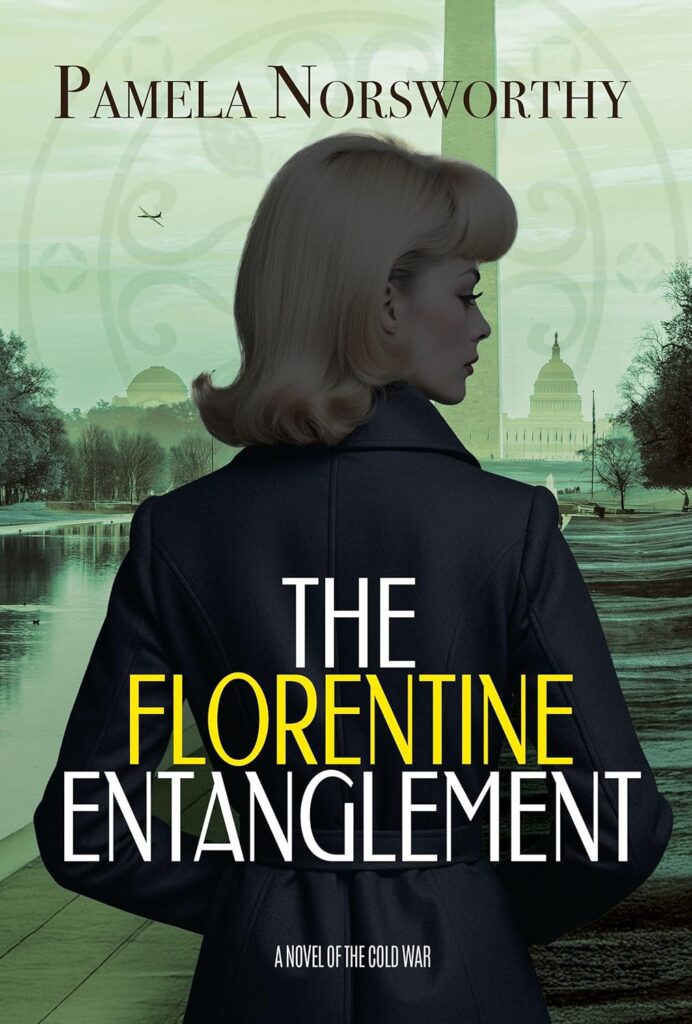
The Florentine Entanglement opens at a surprise 40th birthday party in Washington, DC, where Eleanor Bentley performs gratitude for a roomful of friends, neighbors and government-adjacent acquaintances. Her husband, Talbot, a seasoned CIA officer, arranged the evening as a public gesture of devotion, but the party only sharpens the sense that their marriage has become an elaborate act. By the time he asks Eleanor to wake him for a late-night work call, the domestic unease is already leaning toward something larger. The next morning, the U-2 spy plane mission Talbot oversees has gone disastrously wrong.
It soon gets worse. Talbot’s professional crisis exposes his private recklessness, especially his affair with Helen Sizemore, the ambitious young secretary who knows his office, his routines and his weaknesses. Helen wants more from Talbot than he is willing to give, and her proximity to classified work turns a sordid office affair into a serious vulnerability. As investigators close in, Talbot’s career and freedom are suddenly in jeopardy, while Eleanor, outwardly cool and controlled, must decide how much of herself she is willing to reveal.
Norsworthy builds the novel around a marriage in which both partners have been performing roles for years. Talbot knows Eleanor as a former art student shaped by Florence, fascist Italy, wartime hiding and abandoned artistic dreams. He believes he once drew her out of melancholy when he married her after the war and brought her to Washington, but the novel keeps pressing on the gap between what spouses know, what they assume, and what they choose not to ask.
The novel presents an undeniably stylish sense of surface and setting, moving from Florence’s art world to Washington cocktail rooms, CIA offices, church circles and suburban interiors with an eye for how people stage themselves in public. That attention to clothes, manners, rooms and rituals gives the suspense a polished visual texture, making the social world feel as consequential as the classified one.
One of the book’s best scenes has Helen under interrogation, forced to explain a piece of technology, her access to Talbot’s office and more. It is here that private betrayal becomes evidence, and the book’s central question sharpens – how much damage can a person do when love, vanity and secrecy are allowed to occupy the same room?
Helen is not merely the other woman. She is clever, wounded, vain, professionally frustrated and dangerous because she has been underestimated. Caroline and Rémy Auclair, the Bentleys’ neighbors and intimates, add warmth and unease to the suburban world around Eleanor and Talbot. Around them, CIA investigators, lawyers, clergy, secretaries and social acquaintances create a persuasive mid-century Washington, where reputation, patriotism, gender roles and institutional self-protection are always overlapping.
As the investigation deepens, the novel expands beyond one failed mission and one compromised marriage. Florence, wartime Europe, the remnants of the OSS and the emerging culture of the CIA all press into the 1960 storyline. Norsworthy uses flashbacks not as ornament but as pressure points, gradually reframing motives and deepening the consequences of the U-2 disaster.
With The Florentine Entanglement, Norsworthy delivers a controlled, character-driven historical thriller about espionage, marriage and the cost of living too long under assumed roles. Readers drawn to Cold War suspense, domestic betrayal and morally complicated historical intrigue will find a novel whose private fractures carry public consequences.