
The Bottom Line: Boston Teran has reinvented the conspiracy thriller as a rapid-fire collage of memory, love and violence. Audacious, original and unforgettable.
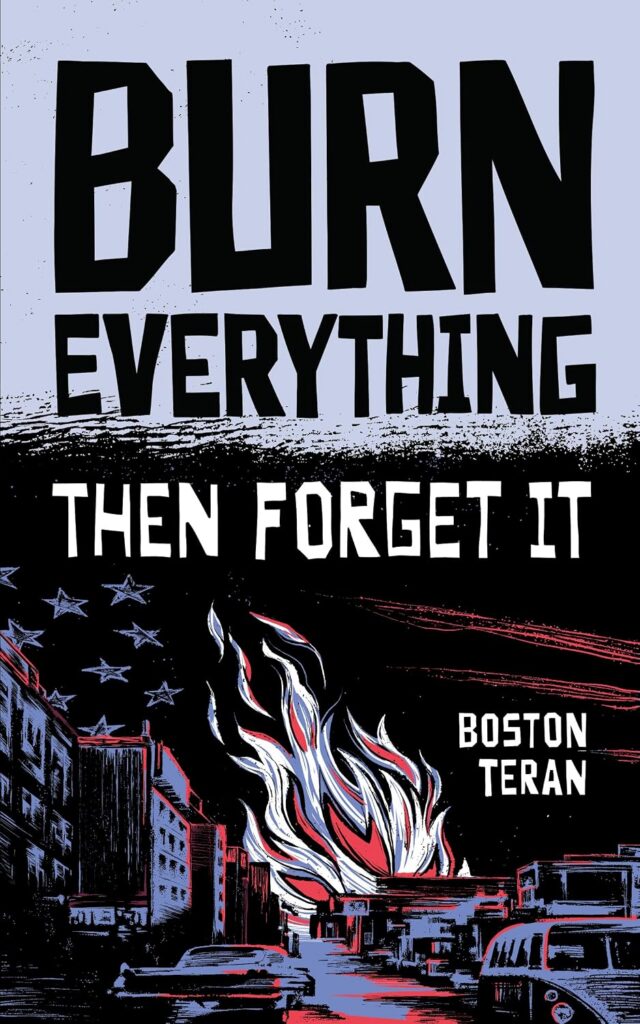
In the opening pages of Boston Teran’s new novel, a car bomb explodes outside a Bronx diner. Debris rains across the front of the diner, and hundreds of photographs scatter through the scene. One of the photographs shows an abandoned building covered in political graffiti. Painted across it are the words that become the novel’s governing proposition: America v. America: Outcome Uncertain.
The words are at once a mystery, a warning and a thesis. Teran’s America is not principally threatened from abroad, though the novel unfolds during the expanding war in Southeast Asia and repeatedly enters the clandestine world surrounding it. Its deeper conflict is domestic: between equality and racial hierarchy, democratic promise and institutional deceit. The country is divided not only in its streets and politics, but also inside its families.
While the book’s themes loom large over its characters, the story itself ultimately belongs to Bill Castle and Viola Dash. Bill provides the novel’s originating wound, with his mother’s murder, his unresolved grief and his struggle not to become defined by violence. But Viola gradually becomes an equal protagonist. She drives much of the investigation, challenges the official and familial versions of the past, and turns the novel from a private trauma narrative into a broader confrontation with political secrecy and inherited complicity. Bill is the character most deeply shaped by what happened. Viola is often the character who forces the truth into motion.
While the book features a large supporting cast, what readers are most likely to remember is Teran’s format, which is too innovative to be anything but a deliberate and bold creative choice. The first thing to know is that the novel is told in 237 chapters, some of them less than one page. For comparison, it’s quite rare for contemporary bestsellers to have more than 90-100 chapters, even if they are short. Going back further, Leo Tolstoy’s Anna Karenina had some 239 chapters spread across 350,000 words. Here, Teran condenses his 237 chapters across approximately 66,000 words, meaning many of the chapters are shorter than a page, and some consist of a single paragraph.
The effect cannot quite be called cinematic, since even longer action movies typically no more than 130 scenes. The effect is actually photographic in nature, recalling the hundreds of snapshots scattered by the opening explosion. Teran cuts rapidly among Bill and Viola’s relationship, the covert work of Warsh and Charlie, political activism, witnesses, operatives and government intermediaries, allowing each section to function like a flash of memory or fragment of evidence. The structure gives the book considerable propulsion, since chapters often end on a threat, revelation or charged image before shifting elsewhere.
Although the novel is predominantly written in the third person, Teran moves the perspective freely among characters, while also stepping outside them to address the reader directly, generalize through the second person, or speak in a collective “we.” These intrusions give the book the quality of an oral history, political sermon and hardboiled chronicle at once. The effect can be forceful and intimate, though it also contributes to the sense that the novel is frequently interpreting its own events rather than leaving every implication to emerge through scene alone.
Overall, the book succeeds as a love story, an indictment and a fast-moving thriller. These elements do not always fit neatly together, but their friction gives the book much of its energy. The country Teran depicts is full of people trying to destroy or conceal evidence, and others determined to recover it. Between them stand Bill and Viola, two damaged people attempting to decide whether truth can become a future rather than simply another weapon.
Teran’s book is likely to resonate with readers concerned with the effects of racial injustice and political corruption, though anyone looking for a remarkable work of literary innovation should move it to the top of their reading queue.