
The Bottom Line: For fans of police procedurals, The Fires of Rubicon is an unforgettable rust belt noir that lingers long after the last page.
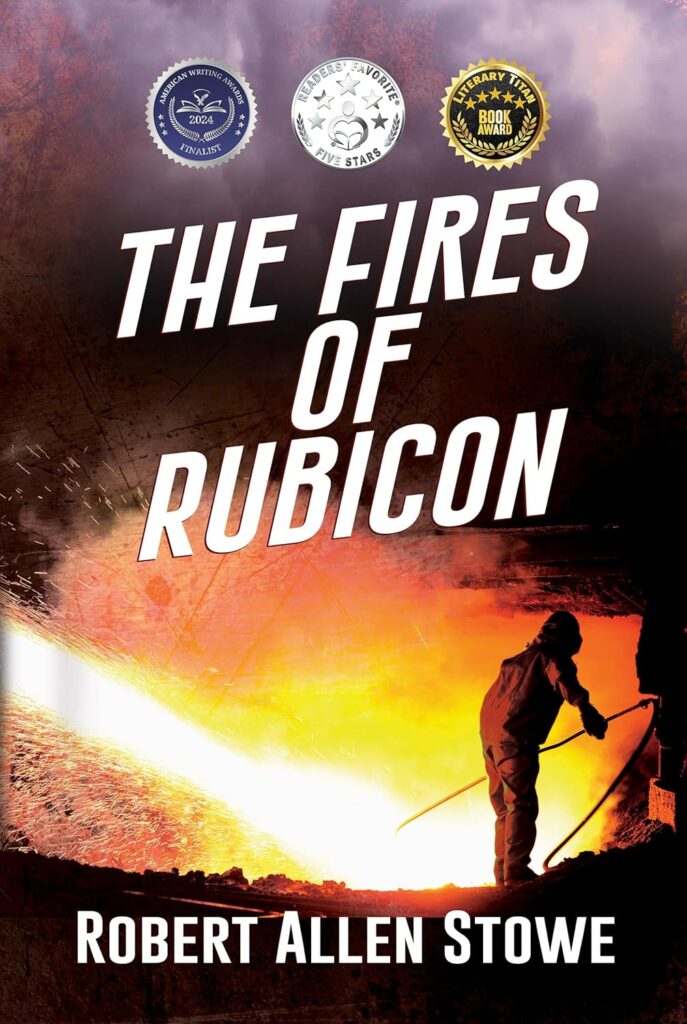
Set in 1971, The Fires of Rubicon opens in Cleveland Police Headquarters, where Lieutenant Alex Wesner and Detective Sergeant Benjamin Friedman question a troubled young man whose account of steelworker Anton Wojcik’s disappearance feels sprawling and unreliable. Anton’s job places him beside one of the book’s most vivid hazards – a molten-steel cauldron so lethal that even the possibility of an accident carries immediate dread. Anton clocked in at Rubicon Steel, but never clocked out.
As they move on with the investigation, one line of inquiry follows Anton’s work, relationships and the possibility that he died at the mill or vanished by design. The other centers on Seazy Ludzinski, whose fractured account hints that he knows far more than he can or will say. Soon after, both lines begin to point toward a wider pattern of violence around Rubicon Steel.
Author Robert Allen Stowe creates an atmosphere that can only be described as rust belt noir. Rubicon Steel isn’t merely a backdrop for crime. It’s actually the novel’s governing weather system. The mills roar, the neighborhoods sag under smoke and neglect, and even the rain seems chemically stained by the industrial valley.
Stowe also makes vivid use of Cleveland, which feels physically abrasive and socially exhausted, a city where economic dependence on the mills has blurred the line between loyalty, fear and silence. At the same time, the novel keeps returning to more intimate wounds: Seazy’s loneliness, Wesner’s buried grief, and the sense that Anton’s disappearance touches complicated bonds of friendship and love. One character’s blunt observation that the deepest motives may come down to money or love neatly captures the book’s early emotional logic.
As Wesner emerges as the novel’s stabilizing force, Stowe broadens the book’s stakes. The inquiry begins with one missing man, but hints of prior incidents, guarded company behavior and legal defensiveness suggest a larger pattern around Rubicon. Just as unsettling is the suggestion that the danger is not wholly outside the squad, since the novel plants early doubt about whether information is leaking from inside Wesner’s own investigative circle.
Stowe keeps tightening the screws until the case yields a final stretch of hard-won answers and reversals.